Quiz and Survey Funnel Revenue Lift in Direct-to-Consumer Brands
Declared preferences from quizzes unlock ongoing revenue through segmented email and SMS campaigns.
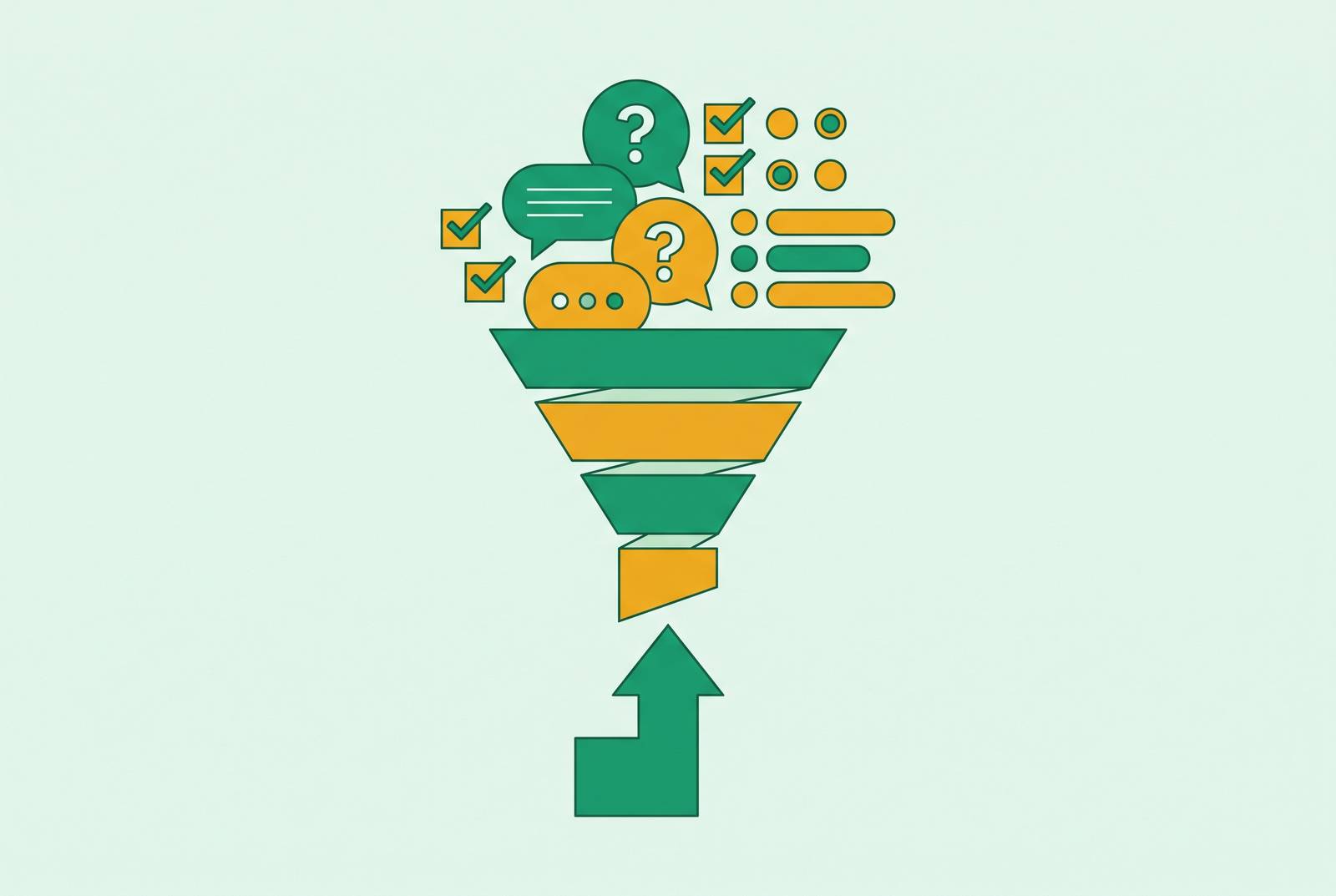
Quiz and survey funnels can lift revenue for direct-to-consumer brands, but the quiz is only the start. The preferences shoppers share keep their value over time through the segmented email and SMS flows that use those answers. Brands that build that downstream system can keep using the data long after the first visit. Brands that stop at a results page leave most of its value unused.
Why the quiz is not the revenue source — the declared-preference data it captures is
A quiz can help convert a visitor, while its answers can shape how the brand markets to that customer afterward. The result page may produce a first purchase. The declared preferences can inform every later product recommendation, email and SMS message. Their value extends beyond the session in which the shopper shared them.
These answers are zero-party data. They are preferences, purchase intentions and personal context that a customer explicitly volunteers. This is distinct from first-party behavioral data, such as clicks and purchases. Making later messages more relevant requires mapping the answers to customer profile properties and using those properties to trigger segmented flows.
The baseline problem — why a static product page cannot do what a quiz does
A standard browse-and-add-to-cart funnel records actions without necessarily revealing the needs behind them. A visitor might view several products, remove one from a cart and leave. Those signals show what happened, but not why. They cannot tell the brand what the customer would have declared about their situation. A better landing page can help make the sale while leaving that gap in what the brand knows.
The gap matters most when shoppers need to think through their choices, as they do with skincare, supplements, haircare and food. A shopper who cannot confidently match a product to a need may leave. A quiz can ask shoppers about their skin type, dietary preference or hair concern before they buy. That turns an unknown visitor into a contact with a usable profile, even if the first visit ends without a sale. The brand then has something more specific to work with than a record of abandoned browsing.
How the four-stage funnel actually works — quiz, capture, recommendation, flow
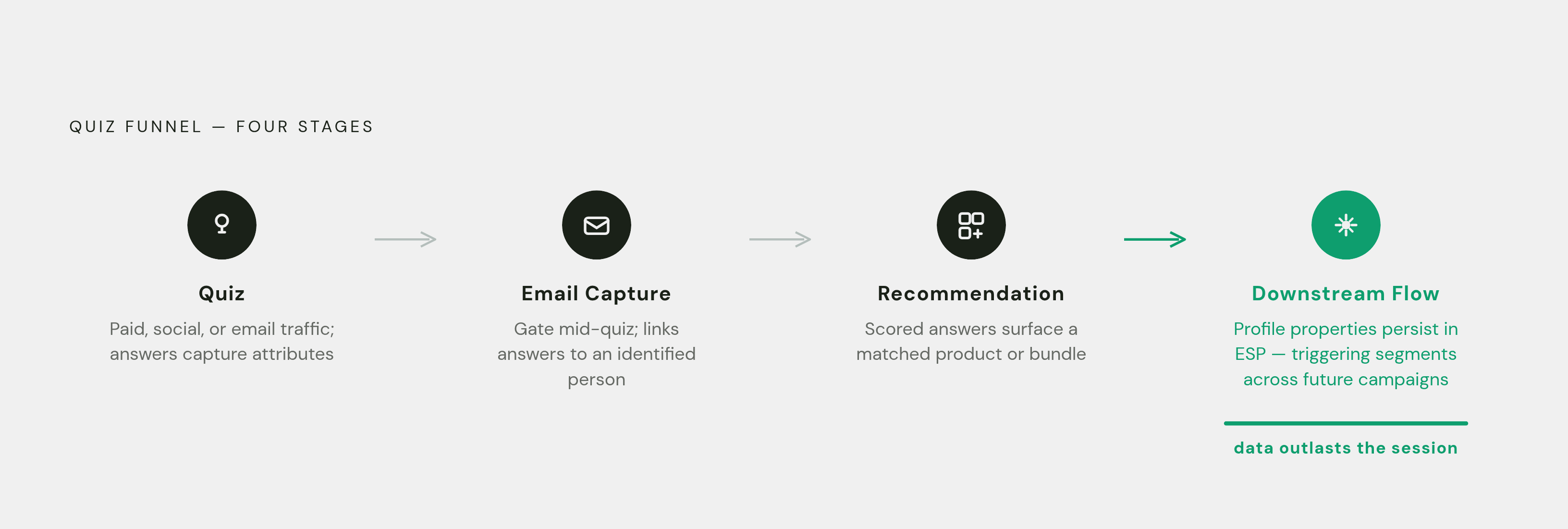
The funnel has four linked stages, which are the quiz, email capture, product recommendation and downstream flow. Shoppers come to the quiz from a paid ad, social post, homepage banner or email. Each question captures an attribute that can guide both the immediate recommendation and later messages.
Email capture links those answers to the person who gave them. Asking for an email before the shopper has invested any effort creates an avoidable point of departure. Placing the gate after a few questions gives the shopper a reason to want the result. Once the answers are collected, weights or tags let the quiz engine score them and surface a matched product, bundle or ranked list. A results page can then offer a discount or an add-to-cart prompt.
In the last stage, those answers go into the email service provider as profile properties. A triggered flow can reference what the shopper actually said, and those properties remain available for future campaigns after the flow ends. RevenueHunt names four measures that show how well this chain works, which are completion rate, quiz-to-cart conversion, average order value and recommendation precision. Together, they distinguish a quiz that people finish from one that matches products well and moves revenue. A break anywhere in the chain limits what the other stages can deliver.
What the psychology of quiz-taking adds to the mechanics
The format also changes how a shopper reaches the recommendation. Answering several questions creates effort investment, so abandoning the result can feel like wasting work already done. Curiosity adds another pull because the promised result is about the shopper. The recommendation then arrives as a conclusion to their answers.
Hike Footwear uses a confession-then-reframe sequence in which shoppers first describe how foot pain affects daily life. A later screen reframes “bad feet” as “feet weakened by bad shoes,” positioning the product as an answer to the problem they have just articulated. Liven uses self-labeling and agreement statements, then shows more of what the problem costs the shopper before showing a pseudo-clinical results page. These sequences illustrate persuasion while leaving open whether a quiz has made a valid diagnosis. Their force comes from getting shoppers to state and consider their own situation before seeing the offer.
Peer validation can reinforce that effect. Hike Footwear tells shoppers it has prepared a summary from people similar to their profile, making the comparison more personal than a generic testimonial. The same expectation carries into later messages. Once a shopper has disclosed personal preferences, relevance is part of the exchange.
What the brands that compound revenue actually do — evidence from the field
Octane AI reports that Hunter & Gather paired a quiz with segmented Klaviyo flows and achieved a 258% lift in email-flow revenue. PACK'd asked quiz takers about lifestyle, including vegan or vegetarian eating habits. Roughly half signed up for the email series that followed. Octane AI says that series is the brand’s best email flow by revenue per person.
Other cases show different parts of the same mechanism. Octane AI reports higher average order value among Unite Hair quiz completers, with the quiz generating a meaningful share of revenue. It also reports that Florae Beauty substantially reduced customer acquisition cost through quiz-led discovery. These are different outcomes, which are larger carts in one case and cheaper acquisition in another. They should not be collapsed into a single generic claim about conversion lift.
Geologie Skincare illustrates the data-volume prerequisite. Octane AI reports that, after eight years with a custom-built quiz, Geologie switched to its platform and achieved a very high completion rate. Completion supplies the answers needed for segmentation, though it is not itself proof of downstream revenue lift. Hunter & Gather, the brand with the lifestyle quiz and Wicked Edge share the more important structural feature: their quizzes serve as permanent data-collection layers feeding ongoing segmentation.
Quiz length, question design, and the email gate — where execution determines whether the data is usable
Quiz length should follow the audience’s starting point. Hike Footwear uses a short quiz for people who already know their feet hurt. Liven uses a longer sequence for people who need help naming the problem. The design rule is to shift the relevant belief before pitching the product, with length serving that task. For most ecommerce brands, a handful of questions can gather useful information without asking shoppers to do too much work.
Within that space, question framing determines how much each answer can do. Asking whether someone has sensitive skin gets a yes or no answer. Asking about triggers, routines and past product failures creates a more precise profile for recommendations and segmentation. Agree-scale statements, as used by Liven, ask shoppers to confirm a belief.
Gate placement determines how many of those profiles become reachable contacts. Moving the email request from the entry screen to just before the results removes a demand made before the shopper has reason to care. But even well-captured answers are snapshots. Skin type, budget, dietary restrictions and a baby’s age can change. Re-surfacing the quiz in email or on the account page at natural intervals keeps segmentation from describing only who the customer used to be.
Where quizzes fail — selection bias, friction costs, and the wrong categories
The published evidence needs a clear qualification. Octane AI, RevenueHunt and Outgrow sell quiz software and publish success stories, so brands that struggled or saw no lift are largely absent from the record. Because of that selection bias, the average published lift gives a poor sense of what an average quiz setup will achieve. The cases show what can happen under the reported conditions. They do not establish what every brand should expect.
In some categories, shoppers have little need for questions to help them find what they want. A quiz before buying an inexpensive candle can give the shopper more to think about without helping them choose. Low-complexity, impulse and single-SKU purchases may need less friction. Better downstream configuration does not erase a poor category fit.
Even in the right category, declared preference is not infallible. Someone may choose “natural and organic” as a priority and then buy the cheapest option, so stated attributes still need behavioral validation. Another failure is simpler, namely collecting rich profiles while leaving the email system configured to send generic promotions. Strong completion and opt-in cannot compensate for an activation step that was never built. For brands in the right category with that system in place, the mechanism is reliable in principle, while the main failure modes remain execution and category mismatch rather than a flaw in collecting declared preferences.
AI-powered branching and the honest case for zero-party data now that third-party cookies survived
Google dropped its Privacy Sandbox initiative in October 2025, leaving third-party cookies in Chrome with no end date. That makes the “cookie apocalypse” an obsolete justification for quiz investment. It does not make declared data less useful. A shopper who describes oily, acne-prone skin and a short window for a morning routine has supplied information that a behavioral pixel cannot infer with equivalent accuracy.
AI-powered branching changes how efficiently quizzes can gather those answers. Instead of following a fixed decision tree, modern quiz engines can use answers accumulated so far to generate the next question dynamically. That can produce a richer profile from fewer questions. But personalization also raises the standard the result must meet. If very different shoppers receive suspiciously similar recommendations, the output undermines the trust the questions were meant to build.
Consent remains a separate obligation. Questions about health conditions, pregnancy or mental wellness can fall under state privacy laws for sensitive data and require clear permission before the answers are collected. A willingness to answer is therefore not a reason to treat every question as routine marketing data. With the right consent and refresh practices, declared preferences offer accuracy, durability and explicit participation that inferred signals cannot match. They are worth collecting as the highest-quality personalization asset available.
Building the activation stack — what the brands that compound revenue have configured before launch
Before the quiz goes live, every answer needs a named customer property in the email service provider. A generic “quiz completed” tag records participation but gives flows no specific preference to use. Properties for skin type, concern and routine time make the answers addressable by campaigns and segments. The minimum flow architecture is then one triggered email flow per major results segment. The first message should already reflect what that contact declared.
Recommendations need testing before traffic scales. Testing must establish whether a given answer set produces the right product. For large or frequently updated catalogs, live inventory sync is another prerequisite. Recommending an out-of-stock product breaks the promise at the moment the shopper is ready to act. Completion rate and attractive results pages cannot repair that mismatch.
The activation stack also reaches beyond email. Profile data from the quiz can help build lookalike audiences and keep existing customers out of acquisition campaigns. A planned re-quiz touchpoint, whether in a post-purchase flow, anniversary email or account-page prompt, keeps those profiles current. The quiz is the instrument, the declared data is the asset, and the activation stack turns that asset into compounding revenue.