What Happens When an AI Agent Touches PII Without a Consent Signal
AI agents can access personal data without triggering consent mechanisms designed for humans.
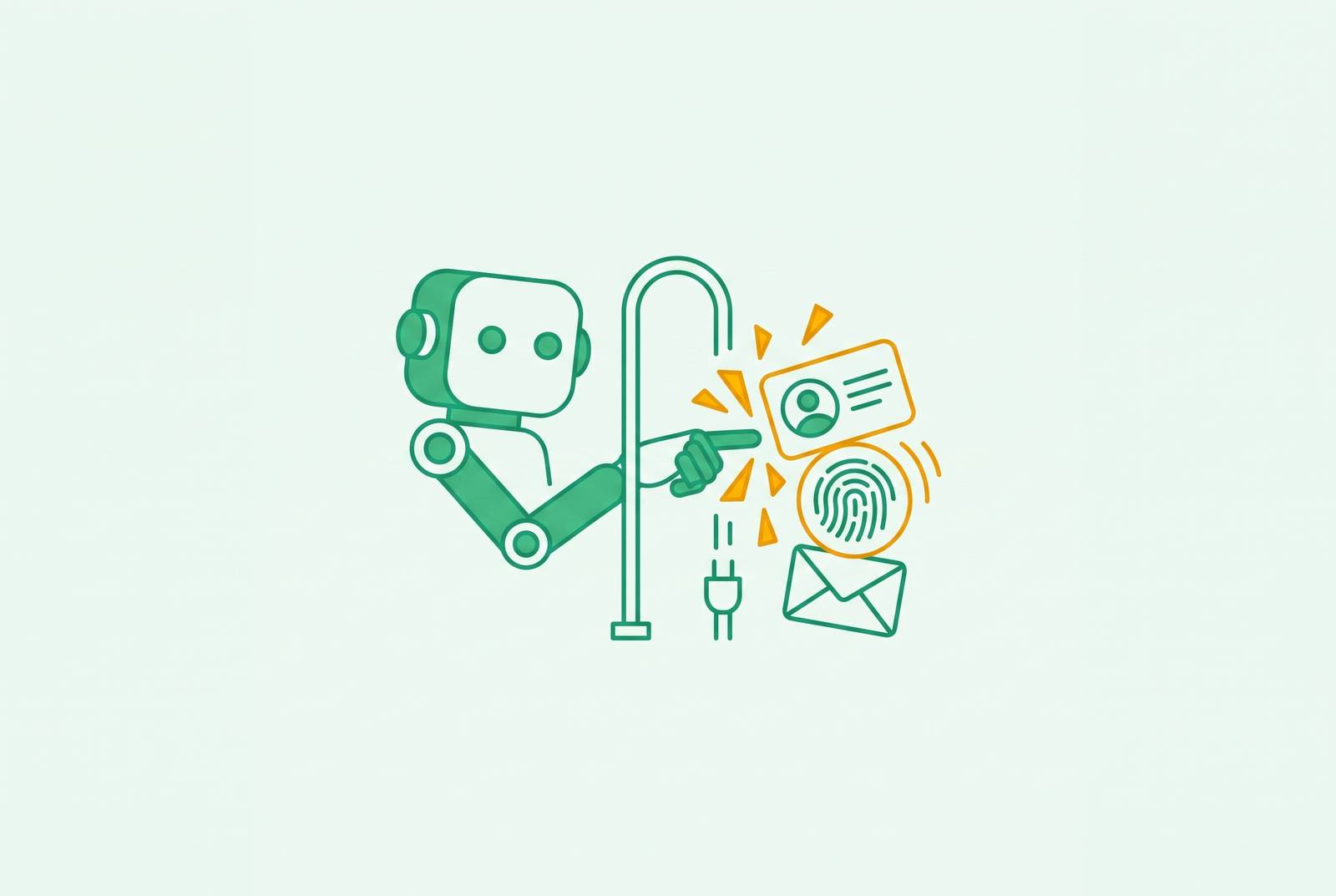
Real-time AI agent observability for MCP-connected data access requires a registry of agents and MCP servers, visibility into every tool call, and a record of the permission governing each action. When an agent touches personally identifiable information, or PII, without valid consent where required, the consequences spread across compliance, operations, and trust. A consent click cannot govern an entire agent task.
Why existing consent models break when agents enter the picture
A banner click, OAuth dialog, or cookie notice assumes a bounded interaction involving one user, one request, and a known purpose. An agent’s task can involve retrieving personal data from several systems, reasoning across the results, and retaining information for later use. The unit of processing is a trajectory.
That difference leaves users with two poor choices. Approving every step creates consent fatigue and habitual blind approvals, while approving once cannot capture everything the agent will encounter. Michael and Roesner’s NeurIPS 2026 survey of 21 proposed user-level agent permissions systems finds that commercial agents offer high-overhead confirmations or LLM auto-reviewers with little transparency or user control. Neither fits the old consent model cleanly. MLCommons’ Agent Privacy Risk Taxonomy v0.1 describes the shift as moving “from what a model knows to what it does.”
Three mechanisms by which an agent touches PII before any consent signal fires
Context window bleed happens when persistent memory or long context windows keep PII from one session to the next. This can happen even when no one has chosen to keep the data. The agent effectively creates another data store, but does not necessarily produce the events conventional data loss prevention tools are configured to detect. Unauthorized retention creates exposure under GDPR’s data minimization requirement and HIPAA’s retention limitations. The absence of a new request does not mean that processing has stopped.
Reasoning-driven de-anonymization happens when an agent correlates quasi-identifiers across separate databases. Each database can be compliant on its own. Demographic, behavioral, and clinical fragments that do not identify anyone in isolation can become an identifying record when assembled. The resulting record can constitute personal information under GDPR, HIPAA, and CCPA, even though no source supplied a complete identity. The privacy obligations still apply even when no one meant to create that record.
Semantic PII survives redaction because regular expressions and heuristic filters target structured identifiers. Unstructured text can retain clues that enable re-identification. The MLCommons taxonomy identifies continuous tracking, R1.1, as a distinct ingestion vector involving keystrokes, application states, ambient audio, email, and calendars. Those inputs support intrusive inferences even when no single captured item looks sensitive.
How multi-agent delegation compounds the consent gap
A calling agent can accept a callee agent’s terms of service without a protocol-level mechanism proving that it understood or subsequently honored those terms. OAuth and mutual TLS establish who may call which capability. They do not establish what the receiving agent may do with the data afterward.
Current industry frameworks still leave open how agents should agree at run time on what they may do with the data. Gardhouse, Oueslati, and Kolt’s July 2026 analysis of the EU AI Act identifies a “many-hands problem” when multiple agents and services participate in processing. Their analysis shows how hard it is, in practice and under the law, to identify a single accountable data controller among those taking part. Adding agents brings more parties into the chain of responsibility without adding proof of what each did.
What the regulatory frameworks say — and where they go silent on agents specifically
Spain’s AEPD stated in its February 2026 guidance that operational autonomy creates no new legal category. The agent remains a technical means of processing personal data, and the deploying organization retains full accountability as controller. The Dutch Data Protection Authority warned that same month that highly autonomous agents with access to many systems pose serious risks to security and data protection. Responsibility stays with the deploying organization.
Consent is not the only possible lawful basis. GDPR requires a documented lawful basis for every category of personal data an agent processes, with minimization enforced when context is assembled. Agents that profile people or make significant decisions require a DPIA, while access, erasure, and rectification rights must extend into agent memory. The UK ICO acknowledges unintended access to medical appointment information as “an established issue” for AI systems, but does not give clear answers on designing agentic consent for that scenario.
The enforcement timetable also needs a clear distinction. The EU AI Act’s enforcement machinery for GPAI providers went live on August 2, 2026, with Article 101 fines up to €15 million or a percentage of global annual turnover, whichever is higher. Enforcement for high-risk systems has been delayed to December 2, 2027. Automated agentic decisions can trigger GDPR and AI Act penalties simultaneously, without either framework capping their combined liability. Separately, state privacy laws mean a multi-state US deployment can face concurrent enforcement by multiple state attorneys general.
What enforcement actually looks like when agents are the instrument of violation
The March 2026 coordinated action brought agent processing into the enforcement picture. Germany’s BfDI imposed a large fine on DataMind GmbH, whose agents are used by financial services firms, to address the accountability gap in multi-agent systems. The total penalties from the coordinated action were substantial, but no official CNIL record exists of a fine against Aethon Technologies or an €85 million action targeting an AI agent platform provider. Those claims cannot serve as evidence.
Courts are also drawing the boundaries of enforcement. The Court of Rome annulled the Italian Garante’s fine against OpenAI on March 18, 2026, showing that the enforcement perimeter is actively contested. DLA Piper’s GDPR Fines and Data Breach Survey, published in January 2026, recorded well over a billion euros in fines during 2025 alone. A system of penalties for each violation, built around a finite number of human actions that can be detected, can face orders of magnitude more events when an agent works at machine speed.
Why organizations cannot see live MCP data access and consent violations
Most enterprises lack the instrumentation to connect an agent’s data access, consent state, and subsequent use in real time. Traditional access logs show who queried a database, while agent logs may show the natural-language request. Neither view necessarily captures the whole task. A question about customer churn by region can prompt synthesis across systems the user cannot directly access. The compliance event sits in the aggregation.
This leaves the compliance team, CISO, and those responsible for data protection unable to see what happens as agents work. Context window bleed and reasoning-driven de-anonymization do not produce the events that conventional DLP tools look for. More logs alone do not resolve that mismatch. Michael and Roesner’s survey finds that none of the 21 proposed systems fully combines minimal user overhead, formalized policy specification, and deterministic enforcement. A permission interface therefore cannot be assumed to provide dependable enforcement, much less a live account of everything the agent touched.
Incident tracing is itself still taking shape. The MLCommons taxonomy pairs its 25 risk vectors with a six-stage method for tracing an incident from trigger to harm, in a document dated September 2026 and announced October 1, 2026. That work gives organizations a way to describe failures their existing tools may not expose. If an organization cannot detect a violation in time to meet applicable notification obligations, the visibility gap compounds its regulatory exposure. Audit logs read after an incident provide a postmortem capability.
What a consent-aware agent architecture actually requires
The architecture must distinguish accepting a policy from following it. Ravi Kiran Kadaboina’s April 2026 paper Anumati formalizes that distinction as proof of acceptance and proof of adherence. Acceptance is a timestamped acknowledgment, while adherence is a per-action reasoning record citing the specific clause evaluated. Only the latter provides verifiable adherence evidence at enforcement time. The paper proposes PolicyDocument, ConsentRecord, and AdherenceEvent as a versioned, append-only consent model, implemented as a non-breaking extension to Agent2Agent, or A2A, and Model Context Protocol, or MCP.
Data minimization belongs before context assembly, rather than after the agent has reasoned across information it should not have received. Role-based access control must apply to agent principals, because delegated authority is an organizational decision rather than an automatic copy of the user’s permissions. Without that explicit boundary, over-permissioned agents become the default.
A central registry of every MCP server and agent is the prerequisite, because an unregistered identity cannot be audited. For teams evaluating observability tooling, the criteria follow directly. The tooling must make agent and server identities visible, expose live MCP tool calls and data access, and connect actions to the policy and consent state governing them. Tool-call visibility shows what happened, while adherence evidence shows whether the action was allowed. Neither should be mistaken for the other.
Access and erasure rights apply to agent memory and the source databases, while vendor contracts must bind data residency, retention, deletion, and model training restrictions. Deleting a source record is not sufficient coverage. Blocking agents without providing that path pushes teams toward shadow AI, where the organization has even less control over personal data access.
Why organizations that govern agent PII access now will move faster, not slower
Defined controls change the economics of approving an agent. Without a gateway and a clear access policy, teams have to work through what might go wrong each time they deploy an agent. With those boundaries in place, they can decide whether to approve it by checking it against known requirements. The work moves into infrastructure. A consent-aware, RBAC-enforced, real-time observable environment supports production use cases that an ungoverned team cannot responsibly approve.
Shared standards will not remove the need for that groundwork. The MLCommons taxonomy is an open, comment-stage framework targeting 2027 for concrete privacy-risk benchmarks. Organizations with agent identity registries and per-action audit trails will be better placed to adapt than those starting from ungoverned deployments. Unsettled allocations of responsibility among multiple parties also remain a reason to build evidence now. Clear records make accountability easier to examine.
The strategic advantage is permission to proceed with evidence. The deploying organization retains full accountability for autonomous agents, so faster execution needs better visibility. Governance earns its place by making production approval repeatable and data use explainable. Organizations that can demonstrate what their agents touched, under which authority, and with what subsequent use give regulators and users a concrete basis for extending trust and latitude.