Google Privacy Sandbox Attribution API Accuracy in Programmatic Buying
Google's privacy API couldn't deliver reliable measurement for most programmatic campaigns.

The Attribution Reporting API, or ARA, was how Google tried to replace cookie-based conversion tracking in Chrome. Its accuracy problems came from the architecture itself, not from how well any given company built on top of it. That distinction matters because it explains why the API's October 2025 retirement was less a surprise than an outcome written into the design from the start.
What the Attribution Reporting API actually was and what it was designed to do
The ARA was built to connect an ad click or view on a publisher's site to a conversion on an advertiser's site, with the matching done entirely inside Chrome. No user-level data left the browser. That was the whole point: instead of a third-party cookie following a person across the web so an advertiser could stitch together the journey, the browser itself would do the matching and hand back only a report.
The API produced two kinds of reports. Event-level reports carried a limited amount of data per conversion, and Chrome held them back for several days before sending them out, specifically to prevent anyone from using the timing or detail to re-identify a person. Summary reports worked differently: they aggregated conversions into coarse buckets and were meant to be the main way advertisers understood how a campaign performed at scale.
Chrome, not the advertiser and not the ad-tech vendor, ran the attribution matching. Chrome generated the reports, and by design they came delayed, aggregated, and short on detail. They still ended up on servers owned by ad-tech companies, just stripped of the granularity those companies were used to working with under the cookie system. That handoff, from rich individual-level data to delayed and bucketed output, is where every accuracy trade-off in the rest of this story begins.
Why the noise mechanism made individual-campaign measurement structurally unreliable
The noise in the ARA's reports was not a side effect of poor implementation. It was the mechanism the whole API depended on to make its privacy promise real, and that is why advertisers could not simply ask Google to turn it down.
The API's specification called for local differential privacy, built using what's known as k-randomized responses. In plain terms: for any single conversion, the device might report nothing at all, report the truth, or generate a fake report, and there was no way for anyone downstream to tell which of the three had happened. That randomness is what protected users from being individually identified through their conversion activity. It's also what made any single conversion record impossible to trust as ground truth.
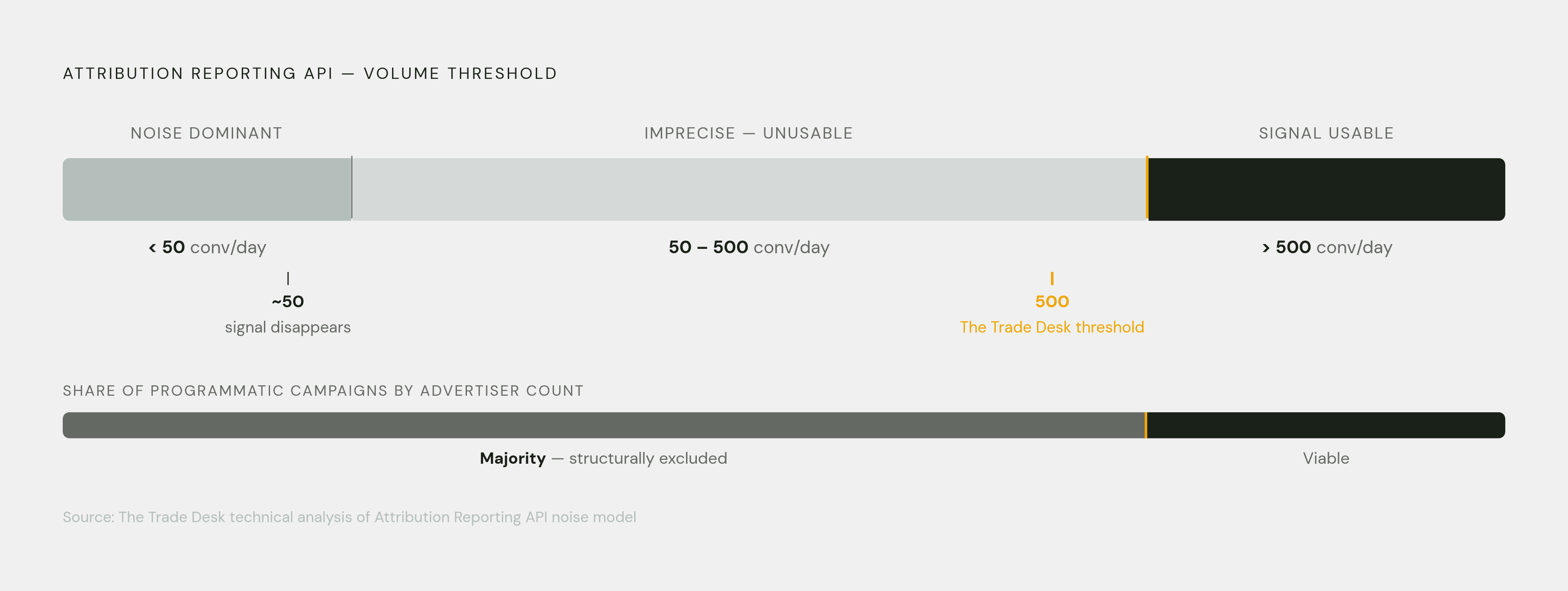
Ad-tech companies could configure the noise parameters, but wider configuration windows only worked if there was enough conversion volume to average the noise out. A campaign running thousands of conversions a day could absorb the random reporting and fake reports and still see a usable signal. A campaign running a few dozen could not. A Trade Desk executive wrote in a February 2026 blog post that the noise parameters at the time made it difficult to optimize campaigns with fewer than 500 daily conversions, cutting out a large share of mid-market advertisers before any testing even started.
The delay compounded the problem. Event-level reports arrived days after the conversion happened, so by the time an advertiser saw the data, the window for adjusting bids or budgets on that specific conversion had already closed. The reports were useful for looking backward, not for steering a campaign in real time. And for summary reports, there was a hard floor: campaigns that didn't clear a minimum conversion volume produced reports where the noise overwhelmed whatever signal was underneath, which meant the output was not merely imprecise. It pointed in the wrong direction.
Error Rates Across Campaign Types in Independent Testing
Organizations ran the ARA against known baselines, and that testing revealed the scale of the problem.
Testing overseen by a UK regulatory authority confirmed that ad-tech companies and ad inventory suppliers would measure conversions worse with the ARA than they had with third-party cookies. For click-through conversion campaigns specifically, more than two-thirds of cases showed Absolute Percentage Error rates above 20% across two of the three Google products examined. An error rate that high doesn't just blur small decisions. It makes campaign-level reporting unreliable for most of the use cases that programmatic buying depends on.
A major ad-tech vendor ran its own test across the majority of its advertising campaigns and publisher inventory, and the results lined up with the regulatory findings. For daily reporting, only a minority of all campaigns reached an average daily conversion count above 10, and anything below that line failed to meet noise thresholds even under the simplest reporting setup available: a daily count per campaign, with no additional breakdown. For hourly bid optimization, only a small fraction of campaigns qualified for hourly summary reporting. Some could substitute a proxy signal called Visits, which roughly quadrupled the number of compatible campaigns, but a proxy signal is still a proxy. It didn't close the gap between what advertisers needed and what the API could deliver.
Google's own testing told a similar story from a different angle. Advertiser spend fell on both DV360 and Google Ads when Privacy Sandbox tools replaced third-party cookies. Publisher revenue per impression dropped on Google Ad Manager and on AdSense as well. Google ran these tests, and the figures it published matched what outside testers and independent reviewers had already found. When a company's internal data confirms what outside testers are already saying, you can't call that a disputed claim anymore. That's the condition the whole market had to plan around.
How the accuracy floor disproportionately excluded mid-market and small-volume buyers
The noise mechanism didn't degrade measurement evenly across the market. It drew a line, with large-volume campaigns on one side and everyone else on the other.
Criteo's own analysis, data Google had access to as well, showed that the largest campaigns, run by the largest marketers, received low-noise and granular reporting under the ARA. Smaller and mid-size advertisers did not have that option. The architecture simply required more volume than they had.
The Trade Desk's 500-daily-conversion threshold wasn't a description of some narrow edge case. By advertiser count, it described the majority of the programmatic market. Most campaigns don't run at the volume the largest brands do, and the ARA's design meant that most campaigns couldn't generate a report worth acting on.
There was no path around this inside the API's own architecture. Stretching the aggregation window out reduced noise, but it also erased the time resolution advertisers needed to adjust bids and budgets while a campaign was still running. Shrinking the window preserved that resolution but let the noise climb back past the point of usability. Advertisers could trade one problem for the other. They couldn't escape both at once.
Criteo's testing exposed a further wrinkle with real competitive weight. Under Privacy Sandbox conditions, specifically the Protected Audience API, Google Ad Manager's share of spend in the treatment population rose from roughly a quarter to more than four-fifths. The measurement gap didn't just hurt accuracy. It appeared to redirect spend toward Google's own advertising stack, an outcome that drew regulatory attention to the whole Privacy Sandbox initiative.
What Practitioners Argued Could Be Fixed
Google's position was that the noise problem had a solution: aggregate over longer time windows, aggregate over larger campaign volumes, and adjust the API's configurable parameters to fit. That answer is true as far as it goes. It just only works for advertisers who already have the volume to aggregate.
Criteo put forward a more substantive proposal: run machine learning models directly inside the Aggregation Services, rather than limiting that service to simply summing up attributed events. Under that approach, models could train with minimal noise, and the resulting weights could get used at bidding time. That's a real engineering idea aimed at squeezing more value out of the data the API did produce, not a complaint about the system.
Other proposed fixes circulated too: reprocessing reports after the fact, building server-to-server integrations around the API's output, finding ways to measure across devices. Each one chipped away at some piece of the problem.
None of them touched the two constraints that mattered most. The noise existed to satisfy a differential privacy guarantee, and loosening it for low-volume campaigns would have broken that guarantee for exactly the users the API was built to protect. The delay on event-level reports existed to stop re-identification, and shortening it would have weakened the same protection from a different angle. Fixes that stayed within the architecture could ease volume-related noise, but only at the margins. Fixes that would have made the ARA genuinely competitive with cookie-based measurement required changing the architecture in ways that gave up the privacy guarantee the whole system existed to provide.
The low adoption rate that confirmed the accuracy problems were not theoretical
Test results and error rates are one kind of evidence. What advertisers actually chose to do with their own money is another, and it's the more convincing one.
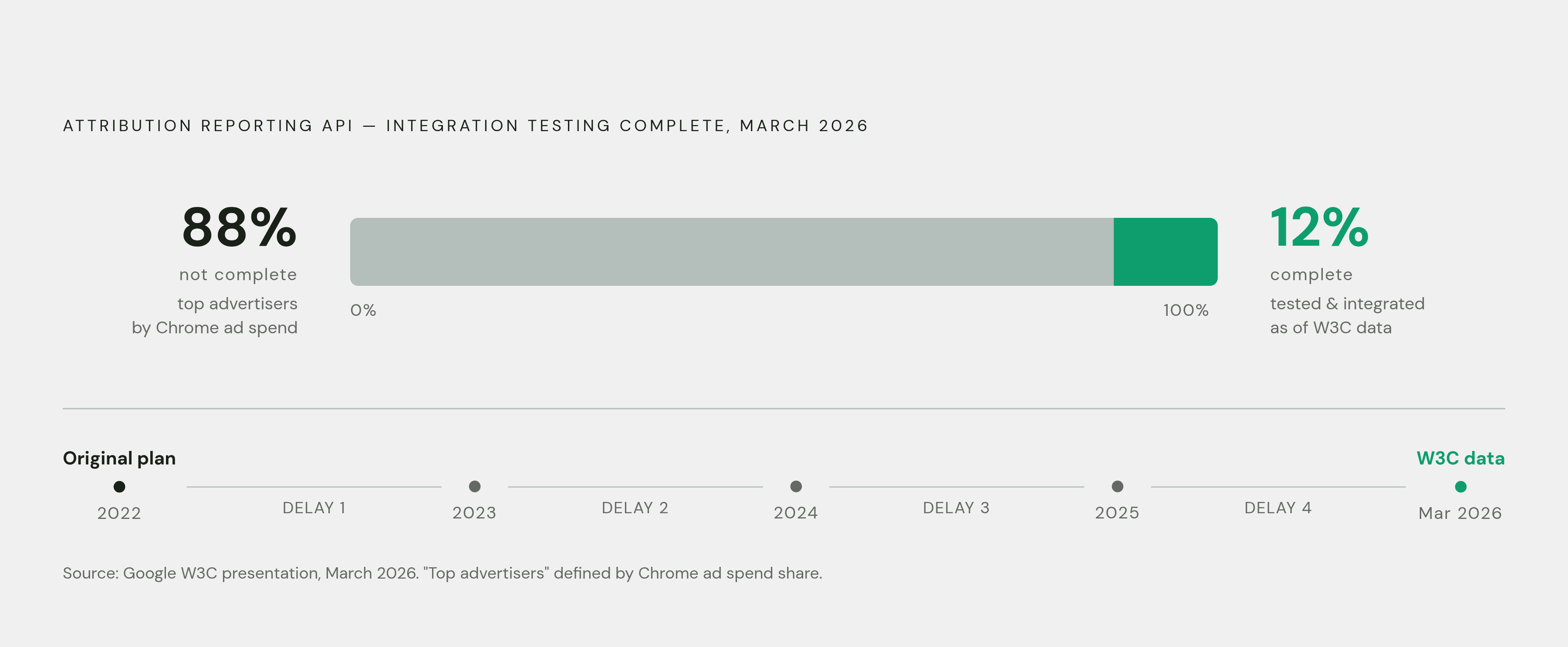
Google shared data at a W3C meeting in March 2026 showing that only 12% of the top advertisers by Chrome ad spend had completed integration testing for the Attribution Reporting API. That figure came after years of development and after four separate delays to the Privacy Sandbox timeline since Google's original 2022 deprecation plan. The companies with the resources to build and test against the ARA looked at what it delivered and mostly didn't finish the work.
Part of that hesitation came from the delays themselves. Every postponement meant advertisers and ad-tech vendors who had already started integrating had to keep running two systems in parallel: the existing cookie-based setup and whatever the Privacy Sandbox version would eventually be, with no fixed date for when the switch would happen. Maintaining two systems at once costs money and engineering time, and third-party cookies didn't carry that cost. Cookies worked the same way across every platform, so there was nothing new to build.
The low completion rate wasn't unique to the ARA either. Topics and Protected Audience showed similarly low numbers at the same W3C meeting, so the problem looks like it spans the whole Privacy Sandbox effort, not just attribution measurement. Sophisticated buyers, the ones who could afford to finish the integration work, looked at the trade-offs across the board and largely chose not to.
Google's October 2025 Retirement of the ARA
On October 17, 2025, Google retired most of the Privacy Sandbox APIs, including Topics, Protected Audience, and Attribution Reporting. Deprecation began with Chrome 144 in January 2026, and removal is targeted for Chrome 152, revised from the original Chrome 150 target.
The retirement didn't fix the accuracy trade-offs this piece has traced through noise, delay, and conversion thresholds. Google ended the API instead, which is itself an answer to the question of whether those trade-offs were something the programmatic market could live with long-term.
Third-party cookies stay in Chrome with no deprecation timeline set. The system Google spent six years trying to replace is, for now, the system still running the market.
Google said it would put its effort into developing an interoperable attribution standard through the Private Advertising Technology Working Group at the W3C, carrying forward feedback gathered from building the ARA rather than continuing the API in its current form. No browser-native replacement is currently in development. The direction Google pointed toward instead is scaled measurement solutions built outside the browser, not a second version of the ARA's architecture. What exactly that standard looks like, and when it might arrive, is still open.
What attribution infrastructure actually works now that the ARA is retired
The measurement approaches that held up through this whole period share one trait: their accuracy never relied on noise added inside the browser.
Server-side conversion APIs sit at the center of that list, since they are the one attribution path that bypasses the browser completely. Meta's Conversions API sends conversion data server-to-server, which keeps browser-level noise from affecting it. Google Ads Enhanced Conversions can also run server-side through the Google Ads API, but its standard web implementation still sends hashed data from the browser. The common thread is that conversion data moves between an advertiser's systems and a platform's systems directly, without a browser-enforced privacy layer sitting in between and degrading the signal along the way.
First-party data and contextual advertising have become the practical center of gravity across the industry following the ARA's retirement. Publishers and advertisers are putting resources into their own data pipelines, building direct relationships with users and audiences, rather than waiting on a platform-level fix that may or may not arrive. Market-level and geo-split incrementality testing fills a related gap: it measures lift by comparing markets or geographies against each other as a complement to last-touch attribution, and it survives this whole episode intact because it never depended on individual-event data to begin with.
None of this removes the need for governance over measurement infrastructure. The ARA's retirement took away a centralized, browser-enforced noise mechanism, but it didn't remove the underlying question of who controls access to conversion data and what's done with it once something, including an AI agent, touches a bidding system or a measurement pipeline. That question used to get answered, however imperfectly, at the browser level. It now falls to each organization to answer for itself, with its own access controls and its own visibility into what's touching its data, since there's no longer a platform-enforced layer doing that job by default.
Sources
- Google Privacy Sandbox officially shuts down: What it means and what’s next
- Feedback Report - 2025 Q1 - Privacy Sandbox - Google
- Summary Reports Optimization in the Privacy Sandbox Attribution Reporting API
- Understanding noise in summary reports
- Differentially Private Ad Conversion Measurement
- Optimizing Hierarchical Queries for the Attribution Reporting API
- Privacy Sandbox Fit Gap Analysis for Digital Advertising