Incrementality Testing Under Consent Signal Loss
Incrementality testing survives consent signal loss because it measures groups, not individuals.

Consent signal loss doesn't break incrementality testing the way it broke attribution. Attribution needs to follow one person from ad exposure to purchase, so when that person declines a cookie, the thread snaps clean off. Incrementality works differently: it compares outcomes between an exposed group and a control group in aggregate, so it never needs to know who any single person is. The signal loss panic marketers absorbed for years turned out to be aimed at the wrong target, and that distinction is the whole story here.
Google retired ten Privacy Sandbox APIs in October 2025: Attribution Reporting, Topics, Protected Audience, Protected App Signals, Private Aggregation, Related Website Sets, On-Device Personalization, SelectURL, SDK Runtime, and IP Protection. Third-party cookies stayed. CHIPS, FedCM, and Private State Tokens survived too. The "cookiepocalypse" that dominated marketing conversation for the better part of a decade predicted the collapse of the wrong thing.
The real signal loss in 2026 comes from three sources that have nothing to do with Chrome: ad blockers, tracking prevention built into Safari and Firefox, and consent banner rejection. In Germany and France, analytics cookie acceptance rates are substantially lower than in other markets. In the US, acceptance runs considerably higher, but that's largely an artifact of the opt-out consent model, where passive user behavior is treated as acceptance. The regulatory environment is doing the damage here, not the browser vendor, and marketers who keep watching Chrome for the next scare are watching the wrong door.
Incrementality testing as the mainstream response to measurement uncertainty
Incrementality testing went from a niche practice to a default expectation in a short window. Two years ago it was something a handful of sophisticated teams ran on the side. Now 52% of US brand and agency marketers run incrementality tests as a standard part of how they measure spend.
Retail media shows the shift most clearly. 71% of retail media advertisers now rank incrementality as their single most important KPI, ahead of ROAS, ahead of attributed conversions, ahead of everything else on the dashboard.
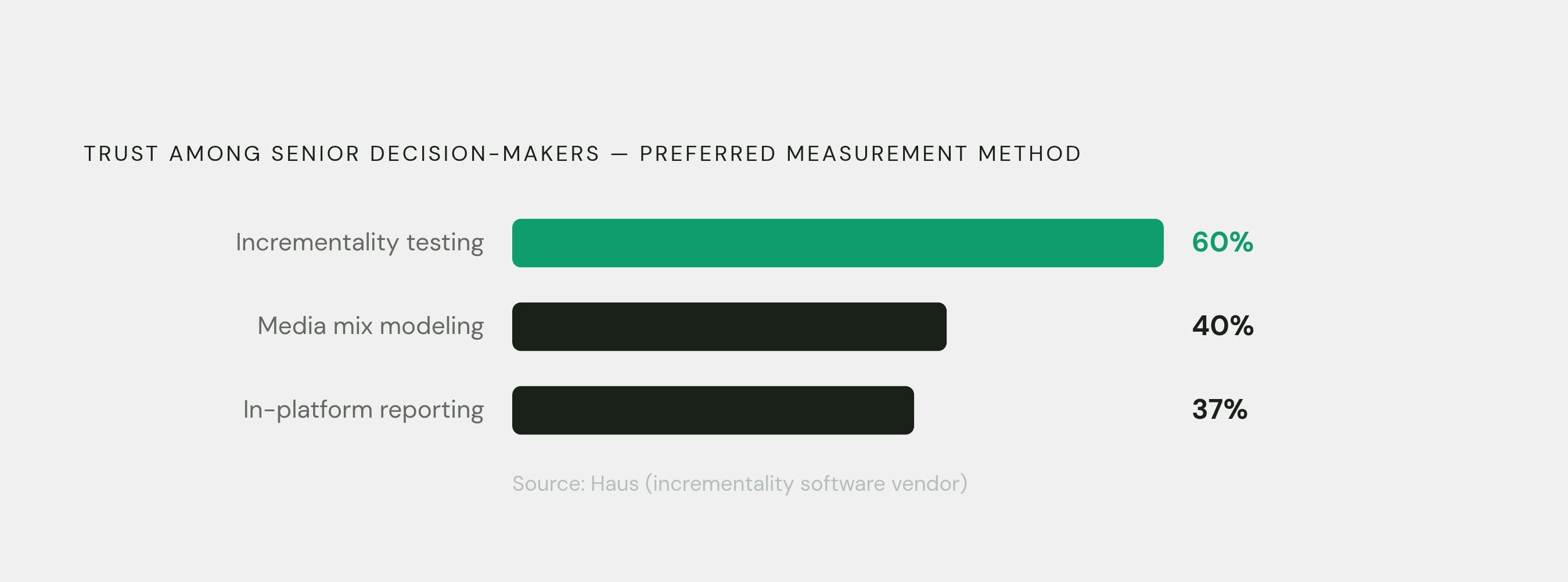
60% of senior decision-makers say independent incrementality testing is the measurement approach they trust most, against 40% for media mix modeling and 37% for in-platform reporting, but that trust comes with a catch. 60% of senior decision-makers say independent incrementality testing is the measurement approach they trust most, against 40% for media mix modeling and 37% for in-platform reporting. That survey came from Haus, a company that sells incrementality testing software. The finding is probably still directionally right, given everything else in this piece, but a vendor grading its own category deserves the same skepticism this piece later applies to ad platforms grading their own performance.
The six ways consent-driven signal loss degrades lift test data specifically
A June 2026 preprint by Prashant Shekhar and Caroline Howard at Embry-Riddle Aeronautical University (arxiv:2606.03878) does something most practitioner discourse has skipped entirely: it models privacy-constrained ad measurement as what the authors call a robust causal decision problem. Instead of asking whether a lift test works or doesn't, the paper treats degraded signal as a condition with measurable boundaries.
Six distinct mechanisms break the test, each in a different way, and each needs its own fix.
Match-rate loss comes first. Users who decline cookies can't be matched to their ad exposure records, so the linked treatment group shrinks, sometimes badly, and what's left is no longer a clean random sample of the population being tested.
Linkability loss follows close behind. Cross-device and cross-session paths break apart. Someone who saw an ad on a phone and converted on a laptop becomes invisible as a connected sequence, and treatment/control assignment gets fuzzy right at the edges where it matters most.
Attribution-window loss is a timing problem. Consent status doesn't remain consistent across a test period, so the observable conversion window is retained unevenly across segments, which skews the comparison in ways that are hard to spot after the fact.
Aggregation-threshold suppression is a side effect of good privacy engineering. Privacy-preserving reporting systems refuse to report on cells below a minimum count, as a built-in protection for individual users. Reasonable protection, but it strips out exactly the granular, segment-level lift evidence that justifies running a test.
Randomized reporting noise gets added deliberately. Platforms inject differential privacy noise into aggregate numbers before they ever get reported. The lift estimate survives, technically, but the confidence interval around it widens, sometimes enough to swallow the entire effect being measured.
Segment-heterogeneous signal loss is the sneaky one. Privacy control adoption isn't even across an audience. Some segments opt out at far higher rates than others, so the signal loss pattern itself correlates with the same audience traits the test is trying to measure. The signal loss pattern correlates with the same audience traits the test is trying to measure, because adoption isn't even across an audience and some segments opt out at far higher rates than others. That's structural bias baked into the sample.
The paper's real contribution is a concept called the decision frontier: a line that separates results that can be certified, positive or negative incrementality stated with real confidence, from results that fall into an "unresolved" zone. Inside that zone, no available method can tell above-threshold incrementality apart from no incrementality at all, given how degraded the signal already is.
"Unresolved" deserves to be a normal answer, and most reporting doesn't treat it that way. Practitioners tend to force a test into binary terms, significant or not, worked or didn't. But an underpowered or heavily degraded test that comes back inconclusive did its job correctly: it reported the limits of what the available signal could support. Treating "unresolved" as if it means "null" is how marketers end up killing channels that were never properly measured to begin with.
Choosing the right test design when signal is constrained
Test design has to match the decision being made, and the amount of usable signal often decides which designs are even on the table to begin with. User-level holdouts work for addressable audiences where individual exposure can be controlled and tracked: email, direct mail, connected TV with device-level targeting. Geo tests fit channels with broad, untrackable reach, like linear TV, out-of-home, or paid search at scale.
Geo holdout testing has earned its reputation as the closest thing to a gold standard for cross-channel incrementality, and the reasoning holds up. It captures effects across every touchpoint at once, since it measures what happens in a market rather than to a person, and it needs zero individual-level cookies to run. Consent banners can't touch it.
Volume is the real constraint on user-level holdouts, not privacy law. Below roughly 500 conversions, the math stops working, confidence intervals blow out too wide to say anything useful. Below that line, a geo test across an entire holdout region is often the only design left that can still produce a readable answer.
Two geo test variants get confused constantly, and they answer completely different questions. A holdout pauses the channel in a set of control markets and asks whether current spend is doing anything. A pulse-up pushes spend in treatment markets above the current baseline, and asks whether there's room to scale the channel efficiently.
A channel can pass one and fail the other. It might be genuinely incremental at its current spend and still have no headroom to grow without diminishing returns, or the reverse: a channel with no incrementality at baseline might show real lift once spend gets pushed higher into a market that was underfunded to start. Picking the wrong test type doesn't just risk a wrong answer. It risks answering a question nobody actually asked.
Power analysis when the test cannot be powered properly
Power analysis has to happen before a test runs, never after. It sets the minimum detectable effect (MDE), the smallest lift the test can actually find given its sample size and runtime. Skipping this step makes a null result impossible to read honestly.
Take a geo holdout across 10 cities, running 17 weeks, with an MDE of 15%. If the channel being tested, say YouTube, has a true incremental lift of 10%, the test is structurally incapable of finding it. The math won't resolve an effect that small at that sample size, full stop. A null result here means the test was never built to see an effect of that size. It means the test was never built to see an effect of that size.
Pre-committing to a decision threshold matters for exactly this reason. Amsive's approach with one client set the rule before the test ever launched: hit 15% or more lift, and the client renews YouTube budget at current levels or higher. Locking that in ahead of time closes off the temptation to reinterpret an ambiguous result after the fact. Most measurement discipline quietly falls apart at that exact point.
When available volume can't support the MDE a decision actually requires, three paths remain, and cutting corners isn't one of them. Lower the bar, changing the decision threshold to something the signal can genuinely resolve. Extend the runtime, letting more conversions accumulate. Or wait, and run the test later once volume grows enough to justify it. Running an underpowered test anyway and treating the output as a verdict is worse than skipping the test, because it hands back false confidence instead of an honest "not yet."
The branded search finding and its implications for holdout design in practice
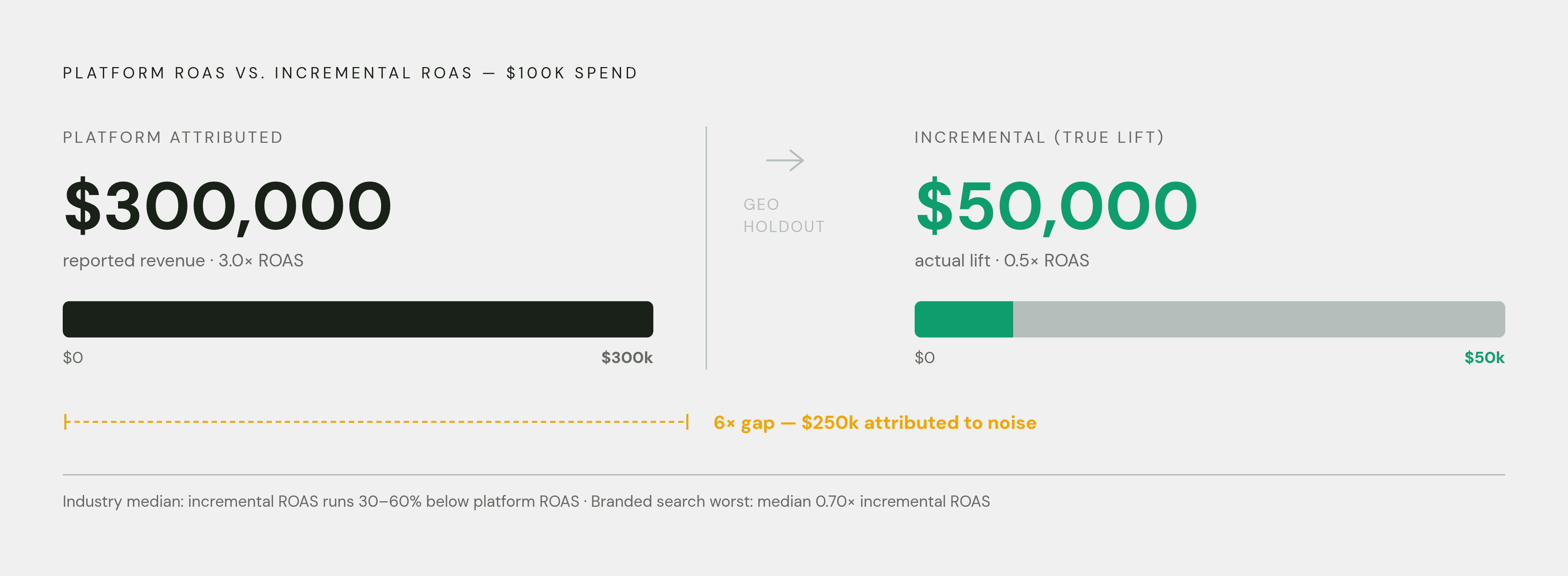
The gap between attribution and incrementality appears starkest in branded search, and the numbers are hard to argue with. Research covering DTC geo-based incrementality tests found a median incremental ROAS for branded search of 0.70x. That's a notably weak result for any channel measured.
Eightx research finds the same pattern industry-wide: measured incremental ROAS typically lands 30 to 60 percent below what the platform reports, and the widest gaps consistently occur in branded search and retargeting, the two channel types most likely to be capturing demand that already existed rather than creating anything new.
Haus lays out the mechanism with a worked example: a brand spends $100,000 on Google Ads and sees $300,000 in attributed revenue, a 3x ROAS by the platform's own count. A brand spends $100,000 on Google Ads and sees $300,000 in attributed revenue, a 3x ROAS by the platform's own count. Running a geo holdout on that same spend often brings the incremental lift closer to $50,000. The platform wasn't lying, exactly. The sale genuinely happened and got recorded accurately. The sale genuinely happened and got recorded accurately, but the platform credited a sale that would have happened whether or not the ad ran.
That's what makes branded search the most instructive test case in the entire incrementality conversation. It's the channel most likely to intercept demand that already existed, the channel where attribution data looks most convincing on paper, and the channel where a properly designed incrementality test most reliably exposes the gap between what attribution claims and what actually happened. Any team still skeptical of running incrementality tests should start there. It's the fastest way to change a skeptic's mind.
What platform-native incrementality products can and cannot replace
Meta built its own answer to this problem: an Incremental Attribution setting built to optimize campaigns toward, in the company's words, "outcomes that are more likely to be directly driven by an ad." Incremental attribution data has been viewable from April 1, 2025 onward, even retroactively on campaigns that ran under standard attribution.
The performance data has actually swung in Meta's favor recently. Across incrementality experiments run between July 2025 and June 2026, Meta's IA iROAS beat standard iROAS by a pooled geo-mean of 1.26x. That's a reversal from the prior year, when IA had been underperforming standard attribution. Meta's own model updates have driven meaningful improvements in incremental conversion measurement relative to the standard attribution model. The tool has clearly gotten better at the job.
The platform's own incrementality measurement has a structural issue: a platform measuring its own incrementality has a built-in incentive to produce findings that justify continued spend on that same platform. A platform measuring its own incrementality has a built-in incentive to produce findings that justify continued spend on that same platform. It's a plain description of the conflict of interest wired into the setup from the start. It's a plain description of the conflict of interest wired into the setup from the start. Better numbers don't remove that conflict, they just mean the conflict currently points in a more flattering direction.
Platforms shouldn't grade their own homework, and nothing about a 1.26x ratio changes that math. Independent holdout tests exist precisely to serve as the outside check that keeps platform-reported incrementality honest, catching the gap between what a platform claims its ads are doing and what would have happened anyway without them.
Triangulating across methods when no single test can be fully trusted
No single method deserves full trust right now. Geo holdouts dodge consent signal loss entirely but give up the individual-level precision that makes user-level tests useful. Platform-native tools like Meta's IA setting have gotten better but still carry a conflict of interest no amount of methodological polish removes. Media mix modeling smooths over noisy channel-level data but leans on assumptions that are hard to check independently. Every method has a blind spot, and the blind spots don't line up with each other.
Triangulation means running more than one of these approaches against the same spending decision and checking where they agree. A geo holdout and a platform-native result pointing the same direction is a far stronger signal than either result standing alone. When they disagree, the disagreement itself is the information: it usually means the channel's true effect sits inside that "unresolved" zone the Embry-Riddle paper describes, where the signal simply isn't clean enough to certify an answer in either direction.
That's not a comfortable place to land, and it won't satisfy anyone who needs a single dashboard number to report up the chain. But treating an unresolved result as legitimate, rather than forcing it into a false yes or no, is what separates a measurement practice built for a signal-constrained world from one still waiting for the old certainty to come back.