Privacy Investment and Cyber Insurance Premium Reduction
Carriers now reward documented controls with lower premiums while penalizing unproven claims.

Application answers on a cyber policy are warranties. A misstatement on a renewal form can void coverage at the exact moment a company needs it most, and that legal weight is what broke the old underwriting model. For most of this market's history, applicants filled out questionnaires about controls they claimed to run, and underwriters had no real way to check the claims. Lockton's February 2026 market update shows how far that's shifted: carriers are now expanding coverage and pricing risk quality differently from one account to the next, a practice that only works if the carrier can actually tell which organizations are telling the truth. Self-attestation has gone from a shortcut to a liability, and for a lot of mid-market firms, the insurance underwriting process has quietly become the toughest annual security review they face, tougher than any voluntary framework they might otherwise adopt.
Uneven Rewards for Well-Documented Organizations in the Soft Market
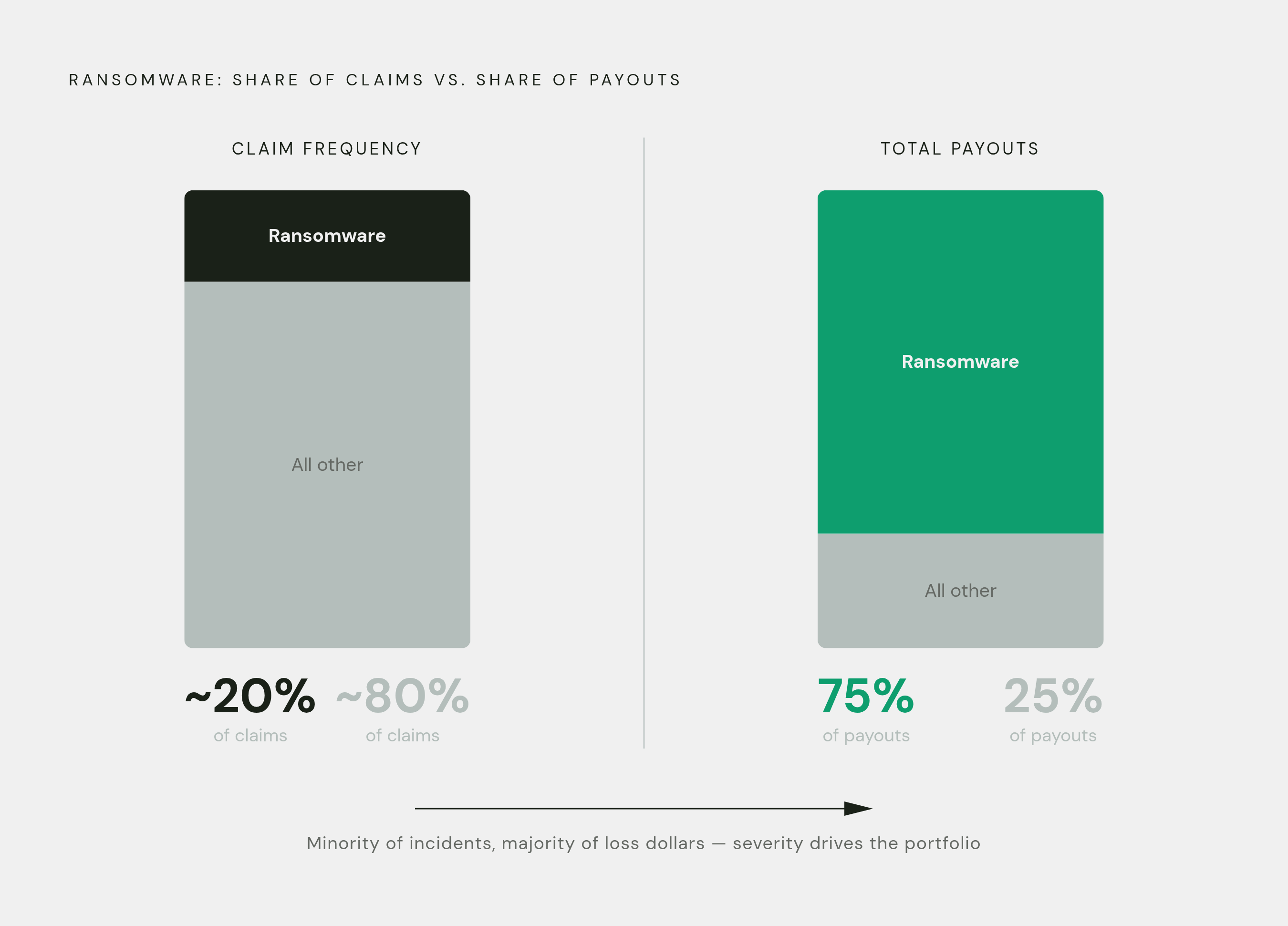
Average premiums are falling, but that average hides a split that matters more than the headline number. Lockton's 2026 update puts the portfolio-wide premium decline at 11% in 2025, and the drivers are carrier growth targets, new entrants chasing market share, and reinsurance dynamics working in buyers' favor, not any drop in actual risk. The same update shows claims notifications rising sharply year over year, and ransomware is a minority of claims but now drives roughly three-quarters of total payouts. Soft pricing and rising severity are happening at the same time, which only makes sense once you see that carriers have stopped setting rates by sector and started pricing individual accounts. Organizations that can produce real evidence of their controls are locking in stable or falling rates. Organizations leaning on self-attestation without proof are picking up surcharges or shrinking sublimits at renewal, even while the market average keeps dropping.
The obvious pushback: this is a pricing cycle, not a structural repricing of risk. Incidents went up while premiums went down, and that gap can't hold forever. Lockton expects further rate reductions at least through the first half of 2026, and S&P Global Ratings has separately said the cycle will turn. Both can be true, and neither changes the underlying logic. Documented controls pay off regardless of which way the market moves. They earn credits now, while the market is soft, and they become a floor once the cycle hardens and carriers start pulling back on capacity. The investment is protection that works in both directions, regardless of market timing.
The Premium Gap Between Documented and Undocumented Organizations
Certification and documented behavior carry a real, measurable price tag in both directions. SOC 2 Type II certification matters to underwriters because it proves controls operated over time, not just that they existed on the day someone filled out an application. That distinction is why it consistently earns additional premium reduction, and for organizations handling sensitive client data, the cost of getting certified can pay for itself through the insurance savings alone.
Coalition runs the logic in the other direction with its "Vanishing Retention" feature, which lets policyholders who show active risk management and security awareness reduce their retention toward zero with each claim-free year. It's a compounding benefit that keeps paying out the longer an organization stays documented and incident-free. Coalition's 2025 claims data backs up the pattern at scale: its policyholders experienced 73% fewer claims than the industry average, a gap the company attributes to proactive investment in security controls, real-time threat intelligence, and continuous monitoring. The benefit of documentation is visible both in the premium and in whether a claim happens.
The floor on the other side has moved up too. Surcharges and reduced sublimits have become the default outcome for any organization that can't produce evidence when asked.
Healthcare shows the limits of what documentation alone can buy. Even if an organization satisfies every underwriting expectation, it still faces premium pressure in that sector, because ransomware targeting clinical settings is severe enough to keep rates elevated no matter the posture. Good documentation there buys renewal at sustainable terms. It doesn't buy a dramatic rate cut, and pretending otherwise would oversell what the evidence supports.
Which controls actually move premiums and what evidence carriers require for each
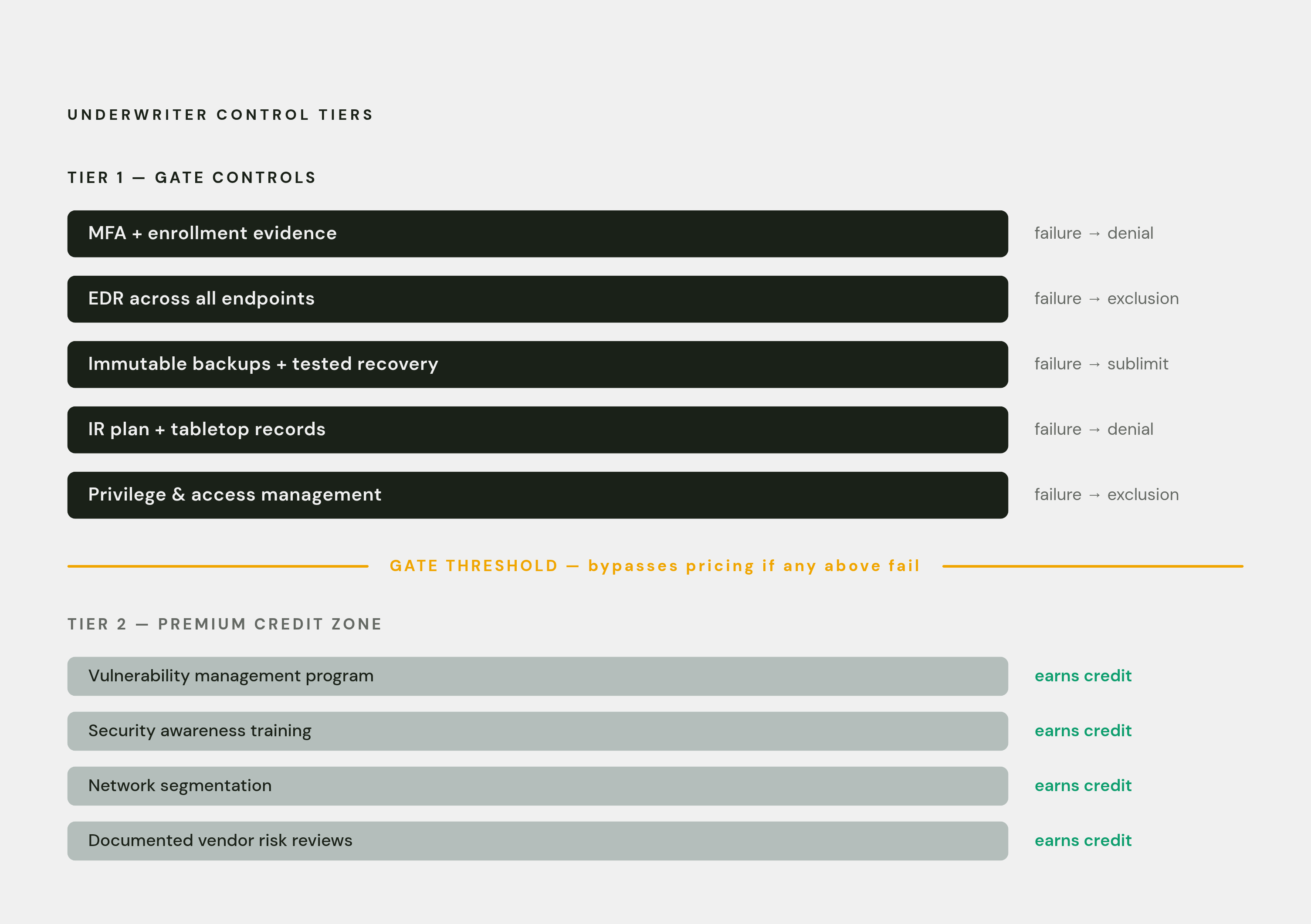
Underwriters now sort controls into two tiers, and mixing them up is the fastest way to misjudge what an investment is actually worth. The first tier is a set of baseline controls that function as gates: miss one, and the consequence is denial, a sublimit, or a ransomware exclusion, not a slightly worse rate. The second tier is documented secondary controls that earn real premium credit, but only after the baseline clears.
Multi-factor authentication is at the top of the gate list, because it's both the most common reason for denial and the control carriers scrutinize most closely. Carriers don't want a statement that MFA is "in place." They want enrollment evidence showing coverage across remote access, email, and privileged accounts, because partial deployment is treated close to no deployment.
Endpoint Detection and Response has replaced legacy antivirus as the minimum standard, because behavior-based detection catches what signature-based tools miss. Here too, carriers want proof that you deployed it across every endpoint, not confirmation that you bought a license.
Backups need to be immutable, and recovery needs to be tested, not just claimed. An organization running immutable storage with annual recovery tests, and able to produce the test results, clears this bar. One that can point only to "we have backups" is a different risk entirely, even if the underlying technology is identical.
Incident response plans need a tabletop exercise behind them, run within the past year, and you need notes or records from the exercise itself. The plan document alone no longer satisfies the requirement.
Privilege and access management rounds out the baseline: limiting and auditing admin rights, disabling dormant accounts, removing local administrator access from standard users, and showing evidence of regular access reviews.
Security awareness training ties directly into claims language. If a breach investigation finds no training program existed, the insurer can reduce or deny payment regardless of how strong the other controls were.
One managed service provider's client saw this play out concretely: after implementing MFA, enabling EDR across all endpoints, and documenting annual backup recovery tests, the client's renewal quote came in materially lower. None of those controls was new in isolation. What moved the price was presenting them together, as a documented package, at renewal.
Continuous Monitoring as the Pricing Mechanism
Your premiums are starting to track your live security posture, replacing the once-a-year snapshot. Carriers are deploying models that pull live data from policyholder networks, adjusting risk evaluation and pricing throughout the policy period. Coalition's approach to active monitoring contributed to a drop in global claims frequency in 2024 even as the threat landscape got worse, and when ransomware events did occur, Coalition Incident Response engaged directly and negotiated a 60% reduction on average against the initial demand. That outcome comes from continuous engagement with the policyholder's environment, not a once-a-year review.
Lockton's update shows carriers extending coverage into exposures like Customer Business Interruption and any-one-claim structures, and offering that kind of coverage requires a higher-confidence risk model than a point-in-time questionnaire can support. The practical shift for any organization: a security posture that slips between renewals is now visible to the carrier mid-policy, and a posture that improves has a real shot at being recognized before the next renewal cycle even starts.
AI governance is the clearest sign of where this is headed. Underwriters are starting to ask whether organizations have AI governance frameworks in place at all, a control category that simply didn't exist in prior underwriting cycles. As continuous monitoring tools mature, that's a category carriers will be able to track in real time rather than check once a year, the same way MFA enrollment and EDR deployment are tracked now.
Regulatory Mandates and the Underwriting Floor
Privacy and security spending that used to be a voluntary differentiator is turning into a legal obligation, and insurers are treating compliance status as a direct underwriting input. A federal critical-infrastructure incident reporting law, targeted for finalization in September 2026, will require critical-infrastructure entities across multiple sectors to notify a federal cybersecurity agency soon after they reasonably believe a covered cyber incident occurred, and to report ransomware payments on an even tighter timeline. It comes with expansive recordkeeping requirements and civil enforcement of subpoenas through DOJ referral. Building the infrastructure to meet those obligations, logging, incident timelines, payment records, overlaps almost exactly with the evidence insurers already ask for as proof of control maturity.
The practical effect is convergence. The control set regulators demand and the control set insurers demand are turning into the same set. An organization building toward CIRCIA compliance is, at the same time, improving its underwriting posture. If an organization falls short on both fronts, the costs compound. For mid-market firms specifically, the insurance underwriting process has become the de facto annual privacy audit: the underwriter is the one doing the annual assessment, and the answers on the application are warranties with real legal teeth. That makes the insurance renewal the single most consequential compliance touchpoint many of these organizations will face all year.
The tail risk behind all of this stays lopsided. Modeled global aggregation loss at a severe return period runs well past current annual premium volume across the market, so one large systemic event could reverse pricing industry-wide, and fast. Reporting mandates like CIRCIA exist partly to close the visibility gap that makes that kind of surprise possible.
Governed AI Access as the Next Privacy Control Insurers Price For
AI agents now touch enterprise data and systems at a scale that underwriting questionnaires have begun to ask about directly. Insurers are already asking whether organizations have AI governance frameworks in place, and as the category matures, demonstrable governance measures are expected to directly shape both insurability and premium levels. An organization deploying AI agents without documented access controls is building up an underwriting liability that hasn't been priced yet, but will be.
The pattern matches what happened with MFA five years ago: a control starts as a differentiator, and once enough loss experience accumulates, it becomes a baseline requirement. So organizations documenting AI governance now are simply getting ahead of a curve that's already forming.
The specific risk here is access breadth. If an AI agent can reach multiple enterprise systems, query sensitive data, and take actions on its own, it creates an attack surface that traditional software architectures don't have. An organization makes that surface governable once it has a registry of what each agent can reach and a record of what it actually did.
It gives organizations access controls, observability, and audit records that turn "we have an AI policy" into proof that AI agent access is actually governed. That's the kind of evidence that moves an AI deployment from an unpriced liability to a documented, defensible posture an underwriter can actually evaluate.
The parallel to existing controls is direct. EDR replaced antivirus as the minimum endpoint standard once behavioral threats outran what signature-based detection could catch. AI-specific governance is on track to replace vague "AI policy" statements as the evidentiary standard once claim frequency catches up with how fast AI gets deployed. That shift hasn't fully happened yet, underwriters are still in the asking phase rather than the requiring phase, but organizations treating AI governance as a competitive advantage now are building the documentation infrastructure that will support favorable terms before those terms get demanded of everyone.
Treating privacy investment as a financial instrument, not a cost center
Everything above points to the same conclusion: documented privacy and security investment behaves like a financial instrument with a measurable return, not an IT expense that shows up once a year on a budget line. It lowers premiums. It narrows the gap between what a claim costs and what the insurer actually pays out. It positions an organization ahead of regulatory requirements before those requirements get enforced.
Healthcare organizations already size security spend against the premium and retention it produces. That framing applies well beyond healthcare. You shouldn't ask whether to invest in the security program. It's how to size that investment against the premium reduction and retention benefit it's expected to produce, modeled across several years.
The documentation discipline that earns underwriting credit is the same discipline that gives a security team real operational visibility. An organization that knows what its AI agents are accessing, can produce MFA enrollment records on demand, and has tested its backup recovery process is also the organization that detects and contains an incident faster when one happens. The same investment serves the insurer's underwriting model and the operations team's actual job at the same time.
The organizations carrying the most underwriting risk going forward are the ones adding new capabilities, AI agents, MCP servers, cloud integrations, without building a governance record alongside them. If you add an access point without documentation, you get both an operational blind spot and a premium exposure nobody has priced yet. The posture that wins is building the governance record at the same time as the capability, so every new deployment arrives with the audit trail and access controls that underwriters will eventually require, and that the business needs anyway to trust what its own systems are doing.