Healthcare Consumer Trust and Appointment Conversion Rates
Online reviews and ratings now determine whether patients ever call your practice.
A parent searching for a pediatrician at 2 AM, worried about a fever that won't break, has already formed an opinion about three or four practices before sunrise, and none of those practices know she exists yet. That's the real shift in healthcare today: the decision to book has moved almost entirely into a research phase that happens before any phone call, any form, any contact at all. By the time a patient reaches out, she has already compared credentials, scanned reviews, and settled on a short list. The call or the click is the end of the decision, not the start of it.
This changes what "losing a patient" actually means for a practice. There are two separate ways a patient never ends up on the schedule. The first is discovery: the practice never appears in the patient's search results, so it never gets a chance. The second is conversion: the patient finds the practice, likes what she sees, and still doesn't book. Both failures trace back to the same source, which is how a practice's digital presence is built and maintained. A clinic can be excellent at medicine, and it can still lose patients at either point, long before a chart gets opened.
The trust threshold patients apply before they will consider booking
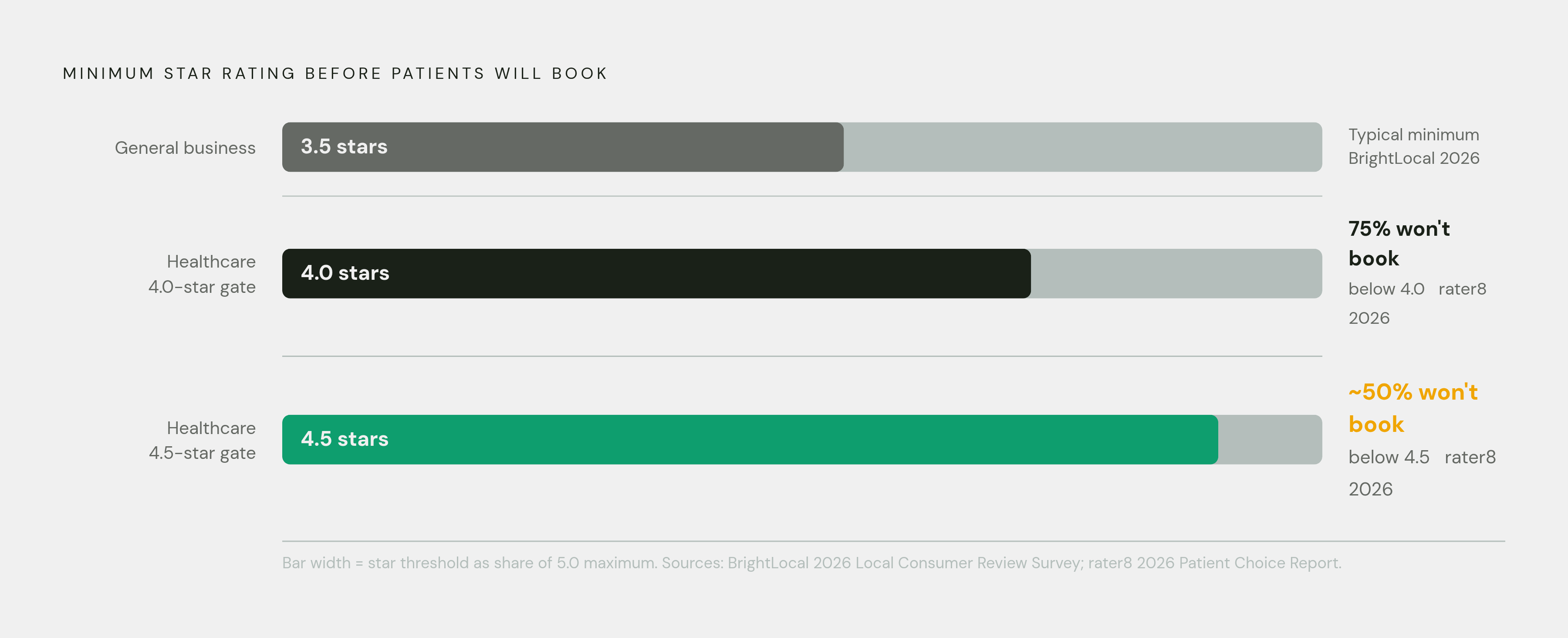
Patients aren't weighing providers on a sliding scale. They apply a hard cutoff, so anything below it gets eliminated before any other factor comes into play. Three in four patients won't book with a provider rated below 4.0 stars, and nearly half won't book below 4.5 stars, the rater8 2026 Patient Choice Report finds. Only a small minority say star rating doesn't factor into their decision at all. For most patients, the rating is a gate, not one input among many.
That gate sits higher in healthcare than almost anywhere else. BrightLocal's 2026 Local Consumer Review Survey shows the minimum-rating threshold across all business categories, and when that number is set next to rater8's healthcare figure, the comparison is stark: healthcare's 4.0-star threshold is measurably higher than the general business standard, and the gap gets even wider at 4.5 stars. Patients will tolerate a mediocre rating for a restaurant or a plumber in ways they won't tolerate for the person treating their child's fever or managing their parent's blood pressure.
The standard is also climbing. Between the 2025 and 2026 rater8 surveys, a span of nine months, the share of patients who canceled or avoided booking because of online reviews rose substantially. Patients are tightening the strict filter they already apply today. A practice can sit comfortably above the threshold this year, but it may not clear it next year, because the bar itself is moving.
What actually drives patients below or above that threshold is not clinical outcomes
The rater8 2026 Patient Choice Report asked patients what in reviews would actually stop them from booking, and the list has an order to it: rude or unhelpful staff, a doctor who didn't listen, substandard care, long wait times, and billing issues. Read that list again slowly. Substandard care sits third, below rude staff and a doctor who didn't listen, and above wait times and billing problems.
Sit with that for a moment. A practice can deliver genuinely excellent medicine and still lose the patient's trust, and the appointment, over how the front desk answered the phone or how long someone sat in the waiting room. The content that tanks a star rating, and therefore knocks a practice below the threshold before a patient ever walks in, is overwhelmingly about the experience surrounding the care, not the clinical substance of it.
This is hard for clinically minded practices to hear: the hours spent on diagnostic precision and treatment quality, while necessary, appear nowhere in the reviews that decide whether new patients ever arrive. A rushed, dismissive five-minute interaction at check-in can outweigh a correct diagnosis in the review a patient leaves that night.
There's a second piece to this that compounds the first. The rater8 2026 survey found that 66% of patients say how a provider responds to online reviews directly shapes whether they trust that provider. That's the largest year-over-year jump across all three editions of the survey rater8 has run, which points to response behavior becoming more decisive over time, not less. Patients are reading whether the practice said anything back, not just what was said about it.
How AI-powered search is moving the trust evaluation upstream, before patients reach a practice's website
Everything described so far happens before a patient ever lands on a practice's website, and now even more of it is happening before a patient ever touches a search results page. AI tools have become the first point of evaluation for a growing share of patients. The trust threshold is now being cleared or failed inside a system the practice never built and can't directly edit.
The rater8 2026 report documents a crossing-over point: AI has, for the first time, overtaken Google search results as the source patients say swayed their decision about care. That reorders the channel hierarchy practices have spent years building their strategy around. Search engine optimization aimed at ranking on a results page still matters, but it's no longer the first or only gate a patient passes through.
AI-powered search pulls together reviews, directory listings, attributed publications, and clinical content, then hands the patient a recommendation directly, often without the patient ever visiting a website, comparing two profiles side by side, or reading an individual review in full. The evaluation happens inside the AI system, and the patient sees only the output.
That compounds the discovery failure with an accuracy failure. Among patients who've used AI to research a provider, a substantial majority have run into wrong information: incorrect addresses, phone numbers, insurance details, or hours. A significant share of those patients just trust the AI summary and never check it against anything else. A practice can have excellent reviews and a genuinely strong reputation, and it can still lose a patient who never calls, simply because the AI surfaced the wrong phone number or listed the wrong insurance network.
Google calls its own search redesign in May 2026 the largest change to search in twenty-five years, and it pushes this further by reducing traditional link browsing in favor of AI-generated answers. The rater8 report cites a measurable drop in organic click-through rates for healthcare search results when an AI overview appears, compared with searches where one doesn't. Large health systems with major IT and marketing departments have already treated this as an operational priority rather than a future concern, so AI visibility isn't an emerging trend for smaller practices to watch from a distance.
For an individual practice, the practical shift is this: every directory listing, every attributed publication, and every piece of review content is now a data point an AI system weighs when deciding whether to recommend that practice at all. The specific wording in a review, not just its star count, carries weight, because AI uses that language to match providers to the particular question a patient typed in.
Where conversion fails after patients clear the trust threshold
Clearing the trust threshold only earns a practice the patient's intent to book, and that intent doesn't last. Patients who are ready to act will go elsewhere fast if a practice is slow to respond, hard to schedule with, or clunky at the exact moment they try to take action. A five-star reputation and a flawless AI profile can still lose the patient at the booking form.
The form itself turns out to be one of the most measurable points of failure. A verification-of-benefits form or an appointment request form that asks for more than it needs creates abandonment at the exact moment a patient's intent to book is highest. Every unnecessary field is a chance for the patient to close the tab.
Security signals matter at that same moment. Fetch and Funnel documents a meaningful increase in form submissions after HIPAA compliance badges and security indicators were added near an appointment request page. Patients asked to hand over personal health information want some reassurance right then, not somewhere else on the site, that the information is protected.
Structural fixes compound these gains. Sweet Media's work with Rize OC shows what happens when paid campaigns get rebuilt with landing pages matched to each specific search query: cost per acquisition fell sharply even as monthly spend scaled up substantially. That improvement came from how the campaign and page were structured.
Mobile page speed is its own dropout point, and a concrete one. Sweet Media's work with California Prime Recovery found that moving to passing Core Web Vitals scores on mobile came with a meaningful drop in paid cost per acquisition. A slow-loading page on a phone is a direct cost to patient acquisition, measured in dollars per booked patient.
There's an honest counterweight to all of this that deserves acknowledgment. A industry research group has pointed out that shortening the time between when a patient schedules and when the appointment actually happens lowers no-show rates, independent of reputation or review content entirely. A practice can have a stellar rating, a flawless AI profile, and a frictionless booking form, and still lose patients if the next available slot is three weeks out. Trust signals earn the patient's attention. Availability and scheduling speed are what keep it. These aren't competing priorities fighting for the same budget. They address different points in the same funnel, one upstream and one downstream, and both have to hold for the appointment to actually happen.
How conversion rates vary by channel and practice type
You can't measure conversion against the whole industry as one number. It moves by channel, by specialty, and by who the patient is. The fixes described above need to be aimed, not applied evenly everywhere.
Channel matters first. Benchmarking data from InnerSpark Creative and WebFX shows paid search outperforming organic search on prospect-to-patient conversion. That's a meaningful detail given everything already said about AI eating into organic click-through rates: a practice that leans entirely on organic visibility is exposed on two fronts at once, losing clicks to AI overviews and not necessarily converting better than paid channels even when the clicks do arrive. That doesn't mean organic search should be abandoned. Directory listings, attributed publications, and review content all feed the AI systems patients increasingly rely on, so organic presence still matters for discovery even where it isn't the strongest converter.
Practice type matters too. A specialist whose patients are making a higher-stakes, less frequent decision, choosing a surgeon rather than renewing with a family doctor, is asking a patient to clear a trust threshold with less familiarity to draw on. That pushes review investment and credential visibility higher on the priority list for specialists than for general practices where patients already have an ongoing relationship.
Where trust signals sit on the page matters as much as whether they exist at all. Sweet Media's conversion rate optimization framework documents that placing credentials, accreditations, and named clinicians near the booking action itself converts better than tucking that same information onto a separate "About" page. Patients decide whether to make contact right there, on the page they're already reading. Asking them to navigate somewhere else to find proof of credibility gives them an exit instead.
Building a digital presence that clears the trust threshold and completes the conversion
Every piece of this argument points toward the same conclusion: a practice's digital presence functions as a single system, and treating its parts separately, reviews here, website design there, directory listings somewhere else, is how practices lose patients they'd already won. Review volume and recency, response behavior, directory accuracy, page speed, form design, and response time after an inquiry all feed into one outcome, which is whether a patient who was ready to book actually does.
Review generation matters, but volume alone doesn't do the work. A hundred generic five-star reviews carry less weight with an AI system than a smaller set of reviews that name specific, concrete things: diagnostic clarity, staff warmth, a provider who followed up after the visit. AI systems extract that language to match a provider to a patient's specific question, so the narrative content inside a review matters as much as the star count attached to it.
Directory accuracy sits right next to this as both a patient-safety issue and an acquisition issue at the same time. A wrong address, a disconnected phone number, outdated hours, any of these can cause a patient to quietly filter out a practice she'd have otherwise chosen, especially once that bad information gets folded into an AI-generated summary she never thinks to double-check. Auditing listings on a regular cadence is a direct line to whether patients can reach the practice at all.
Responding to reviews closes two gaps simultaneously. It's the trust signal 66% of patients say shapes their decision, and it's also a source of the narrative language AI systems use to match a provider to a patient's query. Most practices never respond to negative reviews at all, which makes this one of the highest-leverage moves available because so few competitors are doing it.
None of this works as a one-time project. The practices that come out ahead treat review management, listing accuracy, response workflows, and booking-path design as standing operational infrastructure, maintained with the same seriousness as clinical scheduling or billing systems, rather than a marketing task revisited once a bad review cycle forces the issue. That ongoing attention is what separates a practice that compounds trust and conversion over years from one that's perpetually reacting to the last crisis a patient left in a one-star review.