Mobile Measurement Partner Revenue Decline After ATT Rollout
Apple's privacy update eliminated the identifier MMPs built their entire business model around.

A certain class of attribution vendor never made its money from analytics in the broad sense. They sold one specific thing: deterministic, user-level attribution, the ability to tell an advertiser exactly which ad caused which install, and which install led to which purchase. That precision depended entirely on one piece of plumbing, the IDFA, Apple's device-level advertising identifier. The IDFA worked as a join key. It was stable, it sat on the device, and any ad network, MMP, or publisher could read it. That meant an impression served on one app could be matched to an install recorded on another, and then matched again to a purchase logged inside a third.
Every major feature in the MMP toolkit ran through that same identifier. Nothing about this was one capability among several. It was the capability, and everything else in the product was built on top of it.
That join key also gave MMPs their place in the industry. Advertisers paid for an MMP's report instead of trusting a platform's own self-reported numbers because the MMP held a record built from the same deterministic data every party in the chain could see. The MMP wasn't just another vendor in the stack. It was the neutral party holding the single source of truth that let an advertiser check one ad network's numbers against another's against its own.
What the ATT Prompt Did to the IDFA
App Tracking Transparency did not make the IDFA less accurate or harder to use. It removed the identifier outright for any user who didn't actively agree to tracking, replacing a stable ID with a string of zeros. Calling this an "opt-out" flatters it with a sense of active choice. In practice, a user who saw the prompt and tapped "Ask App Not to Track," and a user who never saw the prompt at all, both end up with zeros, no identifier, no join key. Both outcomes produce the identical technical result.
Five years on, the mechanism is well documented: for the majority of users who ended up in that opted-out bucket, attribution did not become harder or noisier. The entire deterministic pipeline connecting an impression to an install to a purchase, at the level of an individual user, stopped existing for them. There was no degraded version of the old signal to work with. There was nothing.
Three things broke at once, not in sequence. Install attribution for every opted-out user disappeared. Retargeting audiences built from IDFA-matched device lists stopped being usable. And the granular, post-install measurement that ad networks relied on to tune campaigns in real time went dark. A working paper cited in platform-level analysis found that the share of trackable US Apple traffic fell from nearly three-quarters of all impressions to roughly one-fifth after ATT rolled out, a drop measured across billions of ad impressions. That's a collapse in the size of the dataset MMPs were built to work from, not a dip in signal quality.
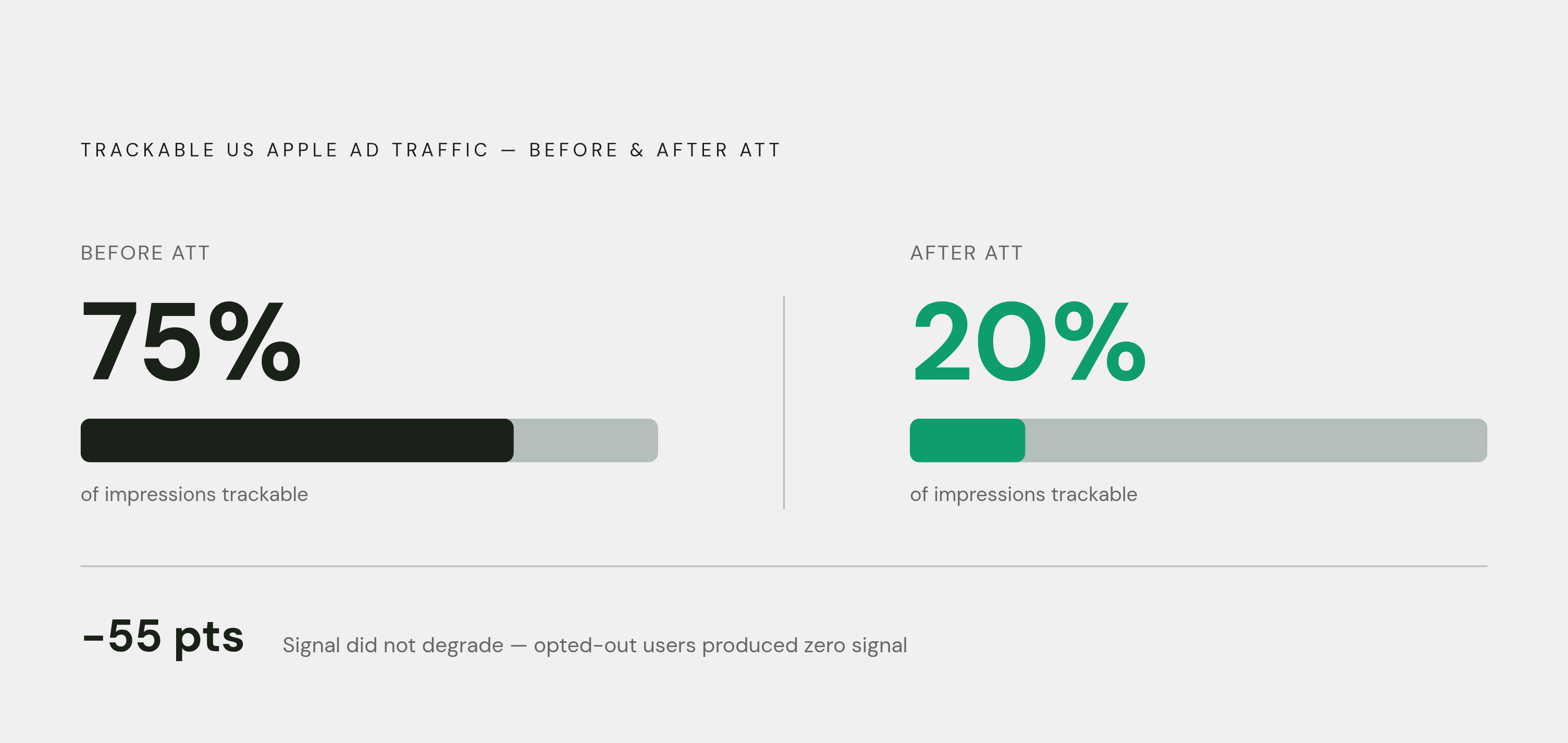
How losing user-level attribution gutted the commercial logic MMPs depended on
Once the deterministic join key vanished for most iOS users, the MMP's entire pitch, that it was the trusted, independent source of truth for attribution, lost its footing for most of the traffic it was supposed to measure. A company can't sell certainty about data it no longer has.
The damage appears in peer-reviewed research. The gap came mostly from weaker new customer acquisition, not from any change in how well these firms retained existing customers.
That matters for MMP revenue because MMP contracts price off usage. Fewer events that can actually be attributed to a user means smaller ad budgets get run through attribution tools, and shrinking budgets mean advertisers trust the tool's output less. All three pressures hit the fee base simultaneously.
The firms hit hardest were the ones that had fueled MMP growth in the first place: small and mid-sized app businesses without the first-party data systems or the statistical staff needed to build modeled alternatives. The MMP's claim to neutrality took a second hit: once most iOS conversions have to be modeled instead of matched deterministically, the MMP stops auditing the platform's number. It starts producing its own modeled guess next to the platform's modeled guess, and neither one can be checked against anything real.
Why the Harm Fell Unevenly
How hard ATT hit a business tracked closely with how much that business depended on identifier-based targeting to find new customers, and that dependency lined up tightly with company size, vertical, and which platforms a business bought ads on.
A Management Science study, published ahead of print, drew on a panel of more than a thousand e-commerce companies. It found that smaller firms with heavy reliance on Meta saw significantly slower revenue growth after ATT than competitors with more diversified platform spend. The mechanism was straightforward: conversion-optimized campaigns, the kind that depend on granular feedback loops, stopped performing the way they used to.
Larger, vertically integrated platforms absorbed the shock better. They already had first-party data systems in place, engineering teams who could stand up server-side conversion APIs quickly, and measurement that didn't live or die on one identifier. Smaller firms faced the same switching cost against a much smaller measurement budget, which made it prohibitive.
Vertical differences made this worse. Gaming is the largest single category of mobile user acquisition spend and the heaviest user of MMP tools, and gaming also has one of the lowest opt-in rates. The damage didn't stop with advertisers, either. Publishers and ad tech intermediaries, especially smaller publishers who lean more heavily on third-party data to support their ad revenue, saw the value of their inventory drop once precision targeting buyers could no longer reach individual users through it.
What Apple offered in place of the IDFA
Apple did give the industry a replacement framework to build around. But that framework was built specifically to prevent the kind of user-level matching that MMP business models depended on. Its limits are the entire design goal, not flaws waiting to be patched.
The conversion value system adds its own limits. Only the first of those three possible postbacks can carry a fine-grained conversion value, a number from zero to sixty-three, and even that only fires once enough users install alongside each other to clear a crowd anonymity threshold. A smaller advertiser running a modest campaign can end up with no usable signal.
MMPs rebuilt their entire integration layer around SKAN and AAK. But what they can hand a client now is aggregate, delayed, and coarse, which is the opposite of the deterministic, real-time, individual-level reporting that justified MMP fees when the category began. Some things did survive ATT intact: first-party event data generated inside an app, Android's Play Install Referrer, deterministic deep links, and server-to-server conversion APIs like Meta's CAPI, Google's Enhanced Conversions, and TikTok's Events API. But all of those signal sources belong to the platform or to the advertiser, not to the MMP. That leaves a narrower lane for an independent third party to add anything unique.
How MMPs rebuilt their business
Faced with the loss of their core join key, MMPs moved away from pure attribution and toward broader marketing data infrastructure. That pivot kept revenue flowing, but it came at a cost to margin, to the clarity of what the product even was, and to the stability of the organizations making the shift.
AppsFlyer's path is the clearest example of where the category has landed. That happened in the same period its CEO publicly acknowledged the company's first profitable year, attributing part of the short-term margin pressure to "significant investments in privacy-enhancing technologies and ecosystem support." AppsFlyer also repositioned its identity, moving from "mobile measurement partner" toward "marketing cloud provider," and rolling out products built around agentic AI to broaden its market beyond attribution alone. Pure attribution stopped being the growth story that justified the company's valuation on its own.
The category overall has drifted toward two alternatives, and neither one restores what MMPs originally sold. One path treats the MMP as an integration layer, pulling together data from SKAN, AAK, CAPI, and modeled conversions into one dashboard. The other path is Marketing Mix Modeling, a method that works off aggregate time-series data and needs no individual identifiers. Neither substitute replaces the granular, campaign-level optimization that MMPs used to sell. That is why the industry's reinvention has dragged on this long instead of resolving quickly.
The conflict of interest the reinvention created
AppsFlyer's decision in mid-2026 to take a billion-dollar investment from Google, Meta, Unity, and Moloco, after walking away from a private equity sale, put the two largest ad platforms on the cap table of the company built to measure them independently. That's a conflict of interest, and it is now a matter of public record.
The conflict isn't a side issue. An MMP's entire value used to rest on being the neutral party that checked what an advertiser spent against what a platform claimed it delivered. Once the deterministic record behind that check disappeared for most iOS users, the MMP's "independent" number became a modeled estimate of its own. A modeled estimate produced by a company now funded by the platforms it's supposed to measure sits in a different position than a deterministic record that anyone could independently verify. None of this reflects on the integrity of any individual company or executive involved. It shows what five years without a deterministic join key did to the category's standing as a neutral referee.
There's a second piece to this that sharpens the point. Apple Ads has grown into the dominant channel for iOS attribution in its own right, and data cited in the five-year retrospective on this period shows SKAdNetwork now accounts for a substantially larger share of iOS attribution volume than Apple Ads carries on its own. Apple now sets the rules of consent through ATT and also runs the leading attribution channel inside that same consent system. The company that removed cross-app tracking now wins the attribution game on the turf it redesigned. The investment and the Apple numbers together show that the independent arbiters of ad measurement have become financially dependent on the platforms they're supposed to check.
The regulatory pushback on ATT
European regulators have looked at ATT and concluded that its architecture tilts the competitive field in Apple's favor. That finding is real: it hasn't touched how the framework actually operates, and the structural condition MMPs face hasn't changed either.
Germany's Federal Cartel Office opened its own investigation into preferential treatment under ATT, extending regulatory scrutiny beyond the French case. But the French authority, despite issuing a fine, did not order any specific change to ATT's architecture, and a Paris court declined to suspend the feature while the case proceeded. ATT's consent framework, and the effect it has on IDFA availability, remains technically untouched regardless of what regulators have found about its competitive effects.
Google's Privacy Sandbox for Android, the project many in the industry expected to become Android's version of ATT, ended in October 2025. That removed any prospect of a cross-platform reckoning that might have forced a broader rethink of privacy-preserving attribution standards across both major mobile operating systems. iOS signal loss stands as a permanent structural condition now, not one half of a larger shift still working itself out across Android. The regulatory pressure is genuine, but it hasn't changed the technical facts MMPs operate under. The industry's reinvention has to be judged on its own merits rather than treated as something to hold out against until ATT eventually gives way.
Five Years of Uneven Recovery in Third-Party Attribution
The recovery from ATT has been slow and uneven for five years, and that unevenness isn't a sign of an industry still catching up. It reflects something simpler: the deterministic infrastructure ATT removed has no direct replacement, and organizations that treated its loss as a temporary data quality problem, rather than a permanent change in architecture, are still paying for that misjudgment.
The organizations that adapted fastest stopped chasing the old signal and started building signal they actually owned: first-party event streams, server-to-server conversion APIs, measurement that doesn't depend on reading an identifier off someone else's device. The industry's broader shift toward Marketing Mix Modeling as the most trusted method among global marketers isn't a retreat to older, simpler tools. It reflects a plain recognition that aggregate, privacy-immune measurement holds up better than user-level attribution in a world where consent is the gate, and opt-in rates have stayed flat for four years running.
MMPs still have a role, just a narrower one than before. As a layer that pulls together platform-specific signals, deduplicates modeled conversions across channels, and keeps a workflow running, an MMP still does real work. That work looks closer to data operations than to the independent measurement authority the category used to claim to be.
That leaves a different question for any organization sizing up its measurement stack. The question isn't which MMP to trust most; it is what signal the organization actually owns outright, and what visibility and control it has over what its measurement tools, and increasingly its AI-assisted attribution agents, can reach on its behalf. The lesson from five years of ATT is specific: signal owned by someone else can be switched off by that party's decision, with no notice beyond a product update. The post-ATT measurement landscape runs on modeled data, pulled from multiple platform APIs, increasingly stitched together by AI-assisted tools acting on an advertiser's behalf. That combination is exactly the kind of ungoverned access to data pipelines that calls for real oversight, not a replacement for the IDFA, but a way to know, continuously, what every tool touching that data is actually doing with it.