Privacy as a Brand Differentiator in Financial Services
Banks lead in privacy maturity, but customers still don't trust them.

Privacy in financial services has stopped being a back-office compliance job and turned into something customers actually notice and act on. The institutions pulling ahead right now are the ones treating governance maturity like a product feature they can show off.
Why financial services leads on privacy maturity, and why that lead is fragile
Financial services is first out of 17 industries in the 2026 TrustArc Global Privacy Benchmarks, with a score of 64%, based on 244 financial services respondents out of 1,844 total. It beats every other sector on the markers that actually signal maturity: 82% of financial firms have board-level privacy review, against 72% globally, and 79% call privacy a competitive differentiator, against 71% globally Cisco Data Privacy Benchmark Study coinlaw.io Thales Digital Trust Index.
That's a real lead. It's also thinner than the headline number suggests. EU and UK-headquartered financial firms score just 56%, the lowest of any financial geography, and that weakness lands right where it hurts most: the EU AI Act's high-risk obligations became enforceable on August 2, 2026. The firms with the least maturity are facing the sharpest new rules at the exact same time.
There's a talent problem underneath all of this, too. The number one ranking is a starting line. It's a starting line. Governance scores measure what's happening inside the walls. They don't say anything about whether the people outside those walls, customers and regulators, actually believe it. In financial services, 44% of respondents cite limited in-house privacy/AI expertise as a barrier, compared with 33% globally, showing that the talent gap hasn't closed even as most firms increase privacy resources, according to the Thales Digital Trust Index Thales Digital Trust Index.
The trust deficit consumers feel, and what drives it
Financial services is simultaneously the most privacy-mature industry and an industry that most consumers still don't fully trust. The 2025 Thales Digital Trust Index found banks led every industry at 44% consumer trust, but no industry cleared 50% Thales Digital Trust Index coinlaw.io. Leading the pack still means most people don't trust you.
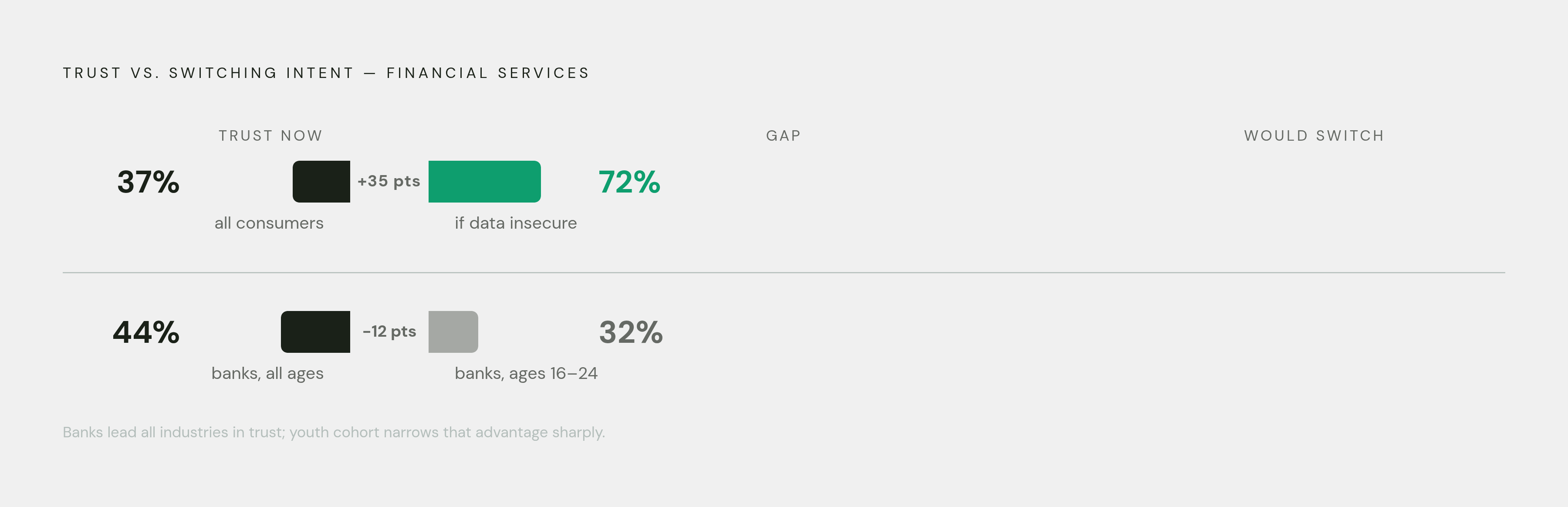
The erosion is worse among the customers who matter most for the next decade. That 44% figure dropped to 32% among 16-to-24-year-olds in 2025, and fintech challengers are the ones catching that skepticism as it falls Thales Digital Trust Index Thales Digital Trust Index. Insurance shows what the floor looks like when trust never really forms in the first place: consumer trust sat at 24% in 2025, flat from 2024, and 37% of consumers said they only hand over data to insurers because they have no other option Thales Digital Trust Index coinlaw.io. That's not a relationship. That's a toll booth.
The gap between what people say and what they'd do is where the opportunity sits. 72% of U.S. consumers say they'd switch financial institutions if they felt their data wasn't secure, yet only 37% currently trust financial institutions to protect their data Thales Digital Trust Index coinlaw.io. That's a lot of switching intent sitting on top of very little confidence, and whoever earns that confidence first gets the business.
What's actually driving the discomfort isn't AI itself. A 2025 Usercentrics study of 10,000 frequent internet users across Europe and the U.S. found 59% are uncomfortable with their data training AI systems, but the underlying issue is a lack of clarity about what's happening to their data, not opposition to the technology State of Digital Trust 2025 / Usercentrics. People aren't rejecting innovation. They're rejecting not knowing.
How consumer behavior turns privacy sentiment into purchase decisions
Sentiment on its own doesn't move revenue. Behavior does, and the behavior here is loud. 81% of consumers say they prefer companies that are transparent about data privacy, and 82% check a company's privacy policy before signing up for a financial product coinlaw.io Pew Research Center Thales Digital Trust Index. Nearly half, 47%, say they'd pay more for financial services that prioritize data security, which turns privacy into a pricing lever rather than just a box to check coinlaw.io.
Product teams should take note of one figure in particular: financial apps built with privacy features saw 63% higher adoption in 2025 coinlaw.io. And among Millennials and Gen Z, over half say they favor financial apps with end-to-end encryption, which tracks directly with the trust collapse among younger users mentioned earlier coinlaw.io.
None of this is soft preference. It appears in churn. The 2025 Thales index found 82% of consumers walked away from a brand in the past year over how it handled their data, and Cisco's Consumer Privacy Survey found 49% of 25-to-34-year-olds switched financial providers specifically over data policy coinlaw.io Thales Digital Trust Index. Across 2024 and 2025, 86% to 87% of consumers consistently demanded a baseline set of privacy rights, with data erasure (53% in 2025) and informed consent (52% in 2025) topping the list as non-negotiable Thales Digital Trust Index.
These are majority behaviors, not fringe preferences. They map straight onto acquisition, retention, and pricing power. So the natural next question is what happens on the other side of the ledger, when an institution loses that trust instead of earning it.
What a breach costs a financial institution, in money, stock, and customers
The number to start with: a data breach in financial services costs an average of $6.08 million, according to IBM's Cost of a Data Breach Report, second only to healthcare and 22% above the global average across all industries IBM Cost of a Data Breach Report coinlaw.io. Banking and payment apps account for 31% of financial sector breaches in 2025, and 41.8% of financial breaches that year trace back to third-party vendors, which means the exposure runs well past the institution's own walls coinlaw.io.
The trust damage lands fast and it lands hard. 94% of breached institutions reported losing consumer trust and loyalty, and 67% of consumers say they'd consider leaving a provider after a breach coinlaw.io pkware.com. Markets react just as quickly: financial company stock prices drop by an average of 6.4% following a breach disclosure pkware.com SEC 2023 cybersecurity disclosure rule. Since the SEC's 2023 cybersecurity disclosure rule took effect, roughly 47 mandatory Item 1.05 filings and 31 voluntary Item 8.01 filings, 78 total as of mid-2026, have hit the market, each typically followed by a stock move of 2% to 7% within 24 hours pkware.com SEC 2023 cybersecurity disclosure rule. Breaches aren't IT incidents anymore pkware.com SEC 2023 cybersecurity disclosure rule. They're investor events.
Preparation changes the math substantially. Firms with regularly tested incident response plans cut their breach costs meaningfully, and those running extensive security AI and automation save a lot more per incident than firms without it. The gap between a prepared institution and an unprepared one isn't marginal, it's the difference between a bad quarter and a crisis. None of this is really an argument about avoiding fines. It's capital allocation, and the return is visible even if nothing else changes, just from the downside avoided.
The regulatory floor in 2026, and why compliance alone doesn't build trust
The rulebook keeps getting thicker.
Globally, the picture is just as dense. DORA took effect in early 2025, covering IT risk across banks, insurers, investment firms, payment institutions, and their critical tech vendors, including cloud providers. The EU AI Act's high-risk obligations became enforceable on August 2, 2026, and the GDPR Omnibus proposals introduced in November 2025 explicitly embed AI into the data protection framework, marking the end of technology-neutral data protection law, per the Future of Privacy Forum's 2026 global privacy outlook. In February 2026, the U.S. Treasury put out its Financial Services AI Risk Management Framework, built with input from over 100 institutions and covering 230 separate operational control objectives spanning governance, data integrity, model risk, third-party risk, and consumer protection.
Consumer-facing rules are stacking up too, from the CFPB's Personal Financial Data Rights Rule to new limits on medical debt in credit decisions to the Homebuyers Privacy Protection Act. All of this reshapes how regulated firms build products. But none of it, on its own, builds trust. Regulation tells an institution what it can't do and what it has to disclose. It doesn't create the kind of open-book transparency that customers actually reward with loyalty. Meeting the floor keeps you out of trouble. It doesn't make anyone believe you. The regulatory landscape is genuinely complex: 20 U.S. states have enacted comprehensive consumer privacy laws, NYDFS 23 NYCRR Part 500 Second Amendment requirements are in full effect as of 2026 with NYDFS in active enforcement mode, NYDFS entered a $2 million civil penalty consent order in 2025, fines have reached up to $30 million in past enforcement actions, and ongoing non-compliance can reach $250,000 per day.
How institutions make privacy visible and credible to customers, not just auditors
The 2025 Usercentrics finding from earlier points the way forward: people aren't rejecting AI or data collection, they're rejecting not being told what's happening. Transparency is what turns a skeptical customer into an engaged one.
Some of the clearest signals are visible at the app level, where customers can see and touch the difference. RFI Global's analysis of banking app interactions through its iSky platform found 13.8% of banks added card-locking features over a two-year stretch, 16% added the ability to close or manage a profile from within the app, and over 10% added in-app card detail viewing. These aren't marketing claims. They're features a customer taps on and immediately understands.
Communication matters just as much as product. Notifying customers proactively when a privacy policy changes signals ongoing effort. Testimonials that speak to specific security commitments, and plain explanations of AI safeguards for customers who want a human in the loop, do the same work. Norton Rose Fulbright's Data Protection Report points to another piece: running full data flow analyses before rolling out new AI tools gives a level of forensic detail that documentation alone can't match, and that detail can be shared outward instead of filed away. Minimizing the data an AI model sees in the first place cuts risk, and it's a specific enough practice that a firm can state it as a promise to customers, not just a technical footnote.
Privacy badges and policy pages are table stakes at this point. Nobody's impressed by them anymore. What actually sets institutions apart is demonstrated control: a customer being able to see exactly what they agreed to, what got accessed, and being able to pull that consent back whenever they want. Individual institutions can build a lot of this trust on their own. But once AI agents start moving across internal systems, a new layer of the problem appears, one that needs governance built for real-time accountability, not quarterly review. While individual institutions can build this externally, organizations that deploy AI agents across systems need an additional layer (the governance that makes AI-driven data access accountable in real time).
Why AI adoption in financial services raises the governance stakes for privacy positioning
AI adoption in the sector didn't creep up, it jumped. Broadridge's Digital Transformation Study found 80% of financial firms are now using AI, up from just 31% in 2025, and roughly a quarter are already running agentic AI, systems that act rather than just answer questions coinlaw.io. TrustArc's 2026 numbers show 77% of financial firms already use AI tools inside their own privacy management functions, but that same 44% expertise gap from earlier is exactly what's holding back good governance of those tools Thales Digital Trust Index Thales Digital Trust Index. The tools got ahead of the people managing them.
Consumers are drawing their own lines here, and they're fairly precise about it. RFI Global's 2026 research on U.S. financial trends found people are comfortable with AI catching fraud, but wary of virtual assistants and automated recommendations, citing accuracy, privacy, and transparency by name as the sticking points. Cisco's Privacy Benchmark Study found the top benefits firms get from putting AI inside privacy functions are regulatory compliance (41%), workflow automation (25%), and data discovery and classification (15%). AI is already doing real privacy work. It's not purely a source of new risk.
The sharpest exposure sits in access control. IBM's 2025 research found that 97% of organizations that suffered an AI-related breach were missing proper AI access controls. That's not a flaw in the models. That's a failure to govern who and what can reach the data at all. Agentic AI raises the stakes further: an agent that can query, read, or act on financial data on its own creates a surface that grows every time it gets a new connection. An institution that can't say, specifically, what its agents touched and when has no credible privacy story to tell a regulator or a customer.
This is the layer where real-time observability and access governance for AI agents matters most, tools that let a firm see and control what its automated systems are reaching into, rather than hoping nothing goes wrong. Institutions that solve for this, governing AI access without slowing down its rollout, are the ones actually converting their privacy maturity into something they can point to and measure.
Treating privacy maturity as a strategic asset that can be measured and demonstrated
The financial case for privacy investment is no longer in question. Cisco's 2025 Data Privacy Benchmark Study found 96% of organizations report that privacy investment benefits outweigh costs, with a median 1.6x ROI, and the key benefits included enhanced customer loyalty (79%), improved operational efficiency (78%), increased innovation (78%), and reduced security losses (76%) Cisco Data Privacy Benchmark Study Qualtrics Consumer Trends Report. A year later, Cisco's 2026 benchmark puts that figure at 99% of organizations reporting measurable benefit Cisco Data and Privacy Benchmark Study. The debate over whether privacy investment pays off is over. What's left is whether a firm can actually show that payoff to the people outside it, customers, regulators, enterprise clients.
Showing it takes a few concrete things. Privacy maturity scores and governance frameworks need to be something a firm can hand to a regulator or an enterprise partner. Real-time access logs and agent audit trails need to prove what AI touched and when, moving governance from a once-a-year audit to something continuously visible. Consent needs to be something a customer can see and revoke. And the 44% expertise gap from TrustArc's 2026 numbers needs real investment behind it, because that gap is exactly where financial services' lead is most likely to slip Thales Digital Trust Index Thales Digital Trust Index.
The firms treating AI governance as an advantage to build, rather than a burden to survive, are the ones earning trust from regulators and users at the same time. The ones that respond by blocking AI tools outright just push the behavior underground: employees find workarounds, and a shadow AI problem appears where visibility used to be. A governed path cuts down on that shadow use far more effectively than a ban ever does.
A 64% maturity score is a floor to build from. The institutions that push past the compliance minimum toward governance they can actually demonstrate are the ones turning trust into something that compounds: repeat customers, room to charge for security, and room to move faster on AI while everyone else is still asking permission. Privacy as a brand differentiator is an operational habit. It's an operational habit that appears in what a customer can see, what a regulator can audit, and what a business can put a number on, and the institutions building that habit now are setting a lead that won't be easy to close.