Trust Signals in B2B SaaS Procurement and Data Access Decisions
Security now decides whether vendors advance in B2B procurement before product features even matter.
A B2B website used to sell. Now it gets audited. Ten years ago the job was simple: introduce the company, flash some credibility markers, get a demo booked. Today the same page gets opened by a security analyst hunting for a reason to say no.
That's the real shift, and most vendors still haven't caught up to it. A buying committee asks whether a vendor can deliver the product, but that part gets assumed; the real question is different. That part gets assumed. Security, legal, and finance want to know whether this vendor turns into a liability six months into the contract, a liability someone eventually has to escalate or unwind. Most marketing sites were never built to answer that, because nobody asked it this early before.
Part of this comes down to volume. SaaS is cheap to build and cheap to launch, so the market's flooded with tools that look sharp on a landing page and fall apart the moment a security reviewer raises questions during a security questionnaire. Buyers have caught on. A skeptical posture at the top of procurement is calibrated to how noisy the category got. It's calibrated to how noisy the category got.
The old playbook stops working here, and vendors clinging to it are the ones stalling in review right now. Logo walls, badge collections, generic testimonials: all of it was built for a sales motion that barely survives at the enterprise level anymore, the one-buyer, one-conversation, relationship-driven close with low downside risk. Enterprise procurement today is the opposite. It runs slow, spreads across a dozen people, and every one of them scans for exposure, not inspiration.
The Buying Committee and Each Stakeholder's Conclusion
Buying committees didn't just grow. They compounded. Average stakeholder count sat around 5.4 in 2014, climbed to 6.8 by 2020, and hit 8.2 by 2024. Roughly double in a decade, and the line hasn't flattened.
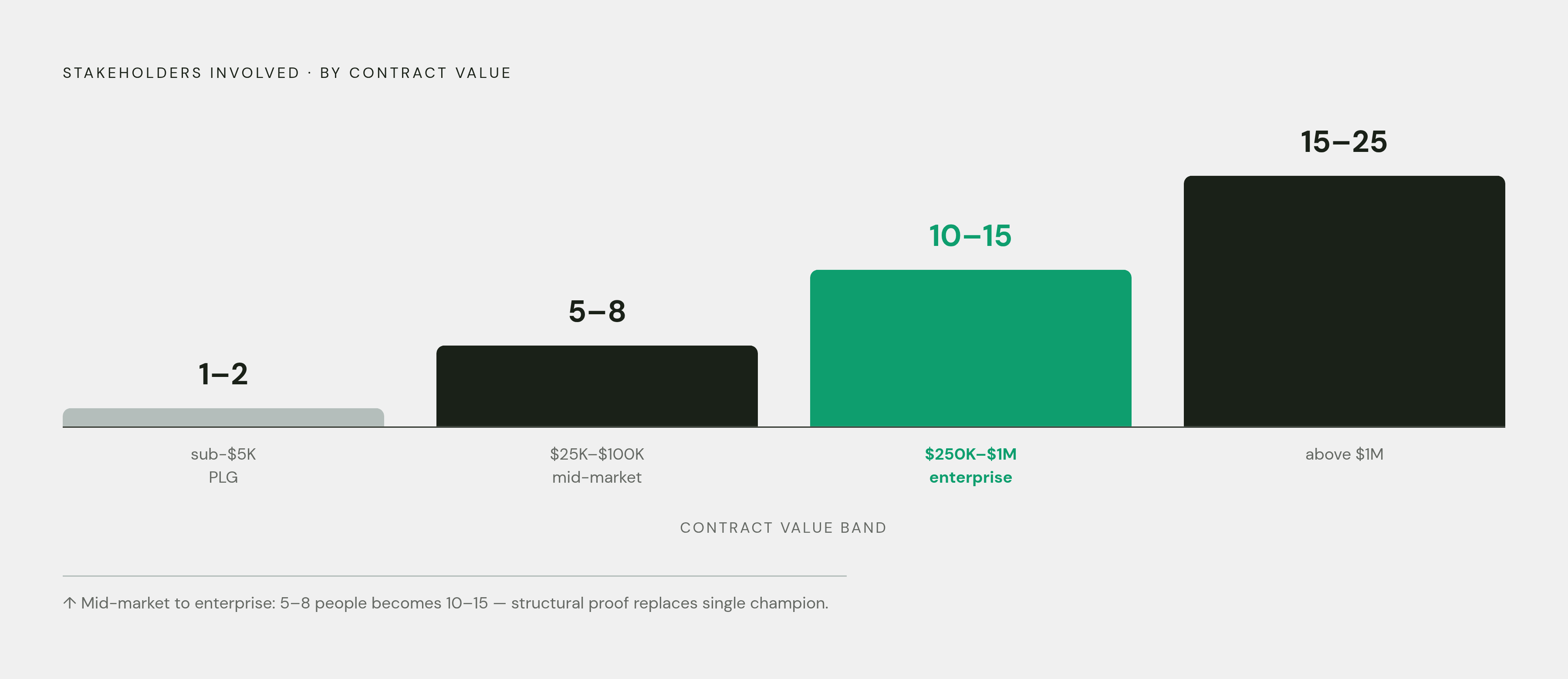
Deal size drives most of that headcount, and the pattern holds across contract-value bands: sub-$5K PLG deals run 1 to 2 stakeholders, $25K to $100K mid-market deals run 5 to 8, $250K to $1M enterprise deals run 10 to 15, and anything above $1M pulls in 15 to 25 people before signature.
Vertical matters just as much as deal size. Cybersecurity deals carry the heaviest committees, typically 8 to 15 stakeholders, with fintech close behind at 7 to 12. That's not a coincidence. Every vertical near the top of that list is one where data access sits at the center of the purchase decision, so more people need a say in what gets touched.
Vendors keep assuming one strong champion can carry a deal through all of this. That assumption is the single biggest miscalculation in enterprise sales right now, because a champion can advocate but can't substitute for proof. Security needs proof of controls. Legal needs contract language that survives an audit, not marketing copy. Finance needs a cost structure that won't blow up in year two. None of them signs off on a testimonial, and none of them will let a champion sign off for them.
Security as the First Filter, Not the Final Checkbox
Security used to show up at the end, a box to check right before signature. Now it's first. 93% of CISOs rank SaaS security as a top priority, and more than half of B2B buyers raise security in the very first conversation, up from just 28% in 2023. A category rewrote its own opening move in under three years, and vendors still pitching product-first are running an outdated script.
The consequence for vendors who can't answer fast is direct. 52% of buyers say they choose vendors specifically because of certifications and data privacy posture, and 57% have already ripped out a SaaS provider over security issues that never got resolved. That second number deserves more attention than it usually gets: it's documented churn that already happened, to vendors who assumed they had more runway than they did.
Real sales conversations back this up. Across 2,216 conversations between B2B support leaders and engineers, questions about SOC 2, GDPR, and single sign-on appeared early in the conversation, and they came from security reviewers, not from support staff kicking the tires on the product. Security gets embedded in the first real conversation now, sometimes before anyone's talked price.
Compliance tends to surface early in the procurement process, through security questionnaires, procurement checklists, and the regulatory context around the data the product touches. Clean, fast answers on any one of those keep the deal moving. Skipping them slows the deal before pricing ever comes up, and there's no recovering that lost time later in the cycle.
Compliance Certifications and Their Signal to a Buying Committee
SOC 2 Type II is the default expectation for US mid-market and enterprise buyers. If that's the target buyer, it's the first thing a security reviewer asks about. No way around it, and no substitute for it either.
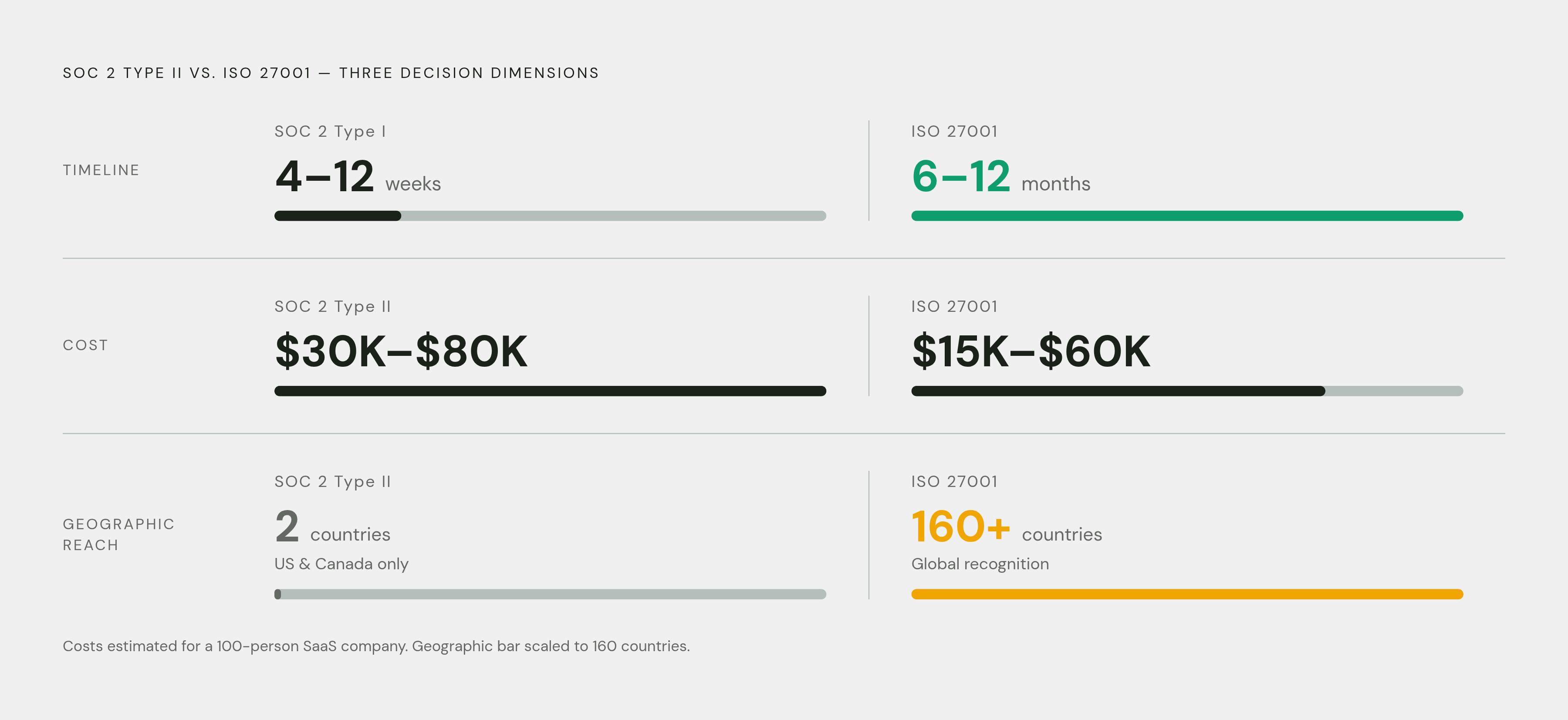
Timeline is where vendors get caught flat-footed, and it's also where the real decision gets made. SOC 2 Type I can be done in 4 to 12 weeks. ISO 27001 typically takes 6 to 12 months. For a company with deals stalling on compliance right now, that gap carries real commercial weight: it closes this quarter instead of next year.
Cost cuts against the assumption most people bring into this decision. SOC 2 Type II for a 100-person SaaS company usually runs $30,000 to $80,000. ISO 27001 usually runs $15,000 to $60,000, often cheaper in raw dollars despite taking significantly longer. The real choice hinges on how much runway a company has and which geography it's selling into, not on sticker price alone.
That geography question has one clear answer, not a toss-up. A single ISO 27001 certificate is recognized in more than 160 countries. A SOC 2 report really only carries weight in two: the US and Canada. Any vendor with EU or APAC expansion anywhere on the roadmap should treat that gap as decisive, not as a nice-to-have for later. Betting on SOC 2 alone while eyeing growth in overseas markets looks fine in year one and turns expensive in year three.
The 2022 revision of ISO 27001 matters most for cloud-native products specifically. It covers 93 Annex A controls across four themes, and the update added cloud-specific controls under A.5.23 along with secure coding practices under A.8.28. Those controls actually describe how modern SaaS gets built, which makes the 2022 version the more relevant standard for a cloud company, not just the newer one.
Trust Centers as the Procurement Artifact That Replaced Badge Walls
A page of compliance badges was once sufficient, but that stopped being enough as buyers began demanding more. Buyers now expect a trust center that behaves like a working tool.
A trust center that survives real scrutiny usually has four pieces working together: NDA-gated document sharing with domain-verified access controls, public compliance status pages and self-serve knowledge bases so a reviewer finds an answer without filing a support ticket, automated responses to standard security questionnaires, and AI-driven chat that answers live security questions in real time.
Trust centers have become a leading contributor to brand trustworthiness in the compliance category, and buyers increasingly check one before contract bids, RFPs, and new product purchases.
The business case isn't subtle, and it isn't close. Trust centers cut conversion time by 32%. Missing security documentation adds 26% to the length of a deal cycle. Same dynamic, opposite direction: give reviewers what they need up front, or watch the deal drag while someone chases down a document that should've been sitting there on day one.
Third-Party and Supply-Chain Risk Management as a Buyer's Due-Diligence Requirement
A significant share of organizations report experiencing a third-party data breach or security incident within the past year. That number alone explains why buyers stopped taking a vendor's word for it. Most of them, or someone on the committee, has already lived through a supply-chain failure firsthand, and nobody wants a repeat with their name on the approval.
Regulation caught up to that reality fast. DORA and NIS2 now make third-party oversight a legal obligation for EU financial entities. For procurement teams inside covered organizations, scrutinizing vendor governance stopped being a preference. It's a compliance mandate with teeth, and it becomes visible as line items in vendor reviews that didn't exist two years ago: what the vendor can access inside a buyer's environment and who authorized each grant, how anyone would know if a sub-processor changed its data handling without notice, and what the incident notification timeline actually looks like, down to who gets told and when.
AI and agentic products sharpen the question further. Buyers want to know what the agent can reach inside their systems and want a record of what it actually touched. Regulated industries need a purpose-built governance layer to answer that, and vendors without one find out mid-deal, usually from the one stakeholder who never showed up to the original sales conversation.
Where surface signals still contribute and stop working
Logo walls and testimonials aren't worthless. They just do a far narrower job than most vendors think, and treating them as a closing tool instead of an opening one is where the strategy breaks down. Research shows a large majority of users form credibility judgments based heavily on website design, and that visual judgment forms within 50 milliseconds, long before anyone reads a word about certifications or controls.
What happens in that half-second is pattern recognition, nothing deeper. A buyer scanning a logo wall isn't asking who's the best vendor in the category. What matters more closely concerns who won't make the buyer look foolish for picking them, and recognizable peer logos answer that narrow question well before real evaluation starts.
Placement changes how much weight a signal carries. Trust signals sitting within 100 pixels of the hero CTA move behavior more than identical signals buried lower on the page. Distance from the point of decision matters almost as much as the content itself, a detail most homepage redesigns get backwards by burying the proof under three scrolls of brand copy.
Specificity beats volume every time, no exception. A named testimonial with a concrete, measurable outcome from a peer in the same vertical and a similar company size shows this will work for a company like the buyer's own. A generic anonymous quote can only answer whether someone, somewhere, likes the product. Once a security reviewer is in the room, only the first kind of answer moves procurement forward.
The structural trust signals that move multi-stakeholder committees through procurement
Everything above points to the same place. Surface signals get a vendor noticed. Structural signals get a vendor through procurement. A logo wall buys fifty milliseconds of credibility. A verifiable, auditable trust artifact buys a signature, and confusing the two is the most expensive mistake a vendor can make on a homepage.
The pattern that separates vendors who close enterprise deals from vendors who stall in review comes down to one thing: documentation the buyer can check without asking the vendor to grade its own homework. That means a SOC 2 or ISO 27001 report a security team can actually read. A trust center with live, self-serve answers. Clear, specific answers to the sub-processor and access-governance questions that DORA and NIS2 have embedded in enterprise vendor reviews. Named, specific proof points from peers in the same industry and size bracket, not anonymous praise that could describe any product in the category.
None of this photographs well on a homepage. A wall of recognizable logos will always look better in a screenshot, and that's why so many vendors keep investing in the wrong artifact. These are the signals that survive contact with an 11-person buying committee, letting security, legal, and finance each reach their own conclusion independently, off evidence instead of assurance. Anything short of that bar just delays the moment the committee finds out on its own.