Zero-Party Data Monetization Models for Media Publishers
Publishers can rebuild ad revenue by monetizing the data audiences willingly share.

Zero-party data is not a consolation prize for the loss of third-party cookies. It is the stronger commercial foundation publishers should have been building all along. The revenue models it unlocks span advertising premiums, direct deals, clean room partnerships, and insight licensing, and each one depends on the same underlying asset: information audiences deliberately share.
Why publishers can no longer treat signal loss as a future problem
Signal loss is not a scenario publishers need to plan around. Google confirmed in April 2025 that it would not roll out a standalone cookie prompt, and by October 2025 it had retired its Privacy Sandbox APIs, Topics, Protected Audience, and Attribution Reporting, citing low adoption. Cookies survived, but the alternative infrastructure that was supposed to replace them did not materialize.
The browser landscape tells the same story from a different angle. Consent banners, ad blockers, and privacy laws compound the gap. A strategy built only on cookies is a strategy built on an audience fraction, and that fraction is not growing.
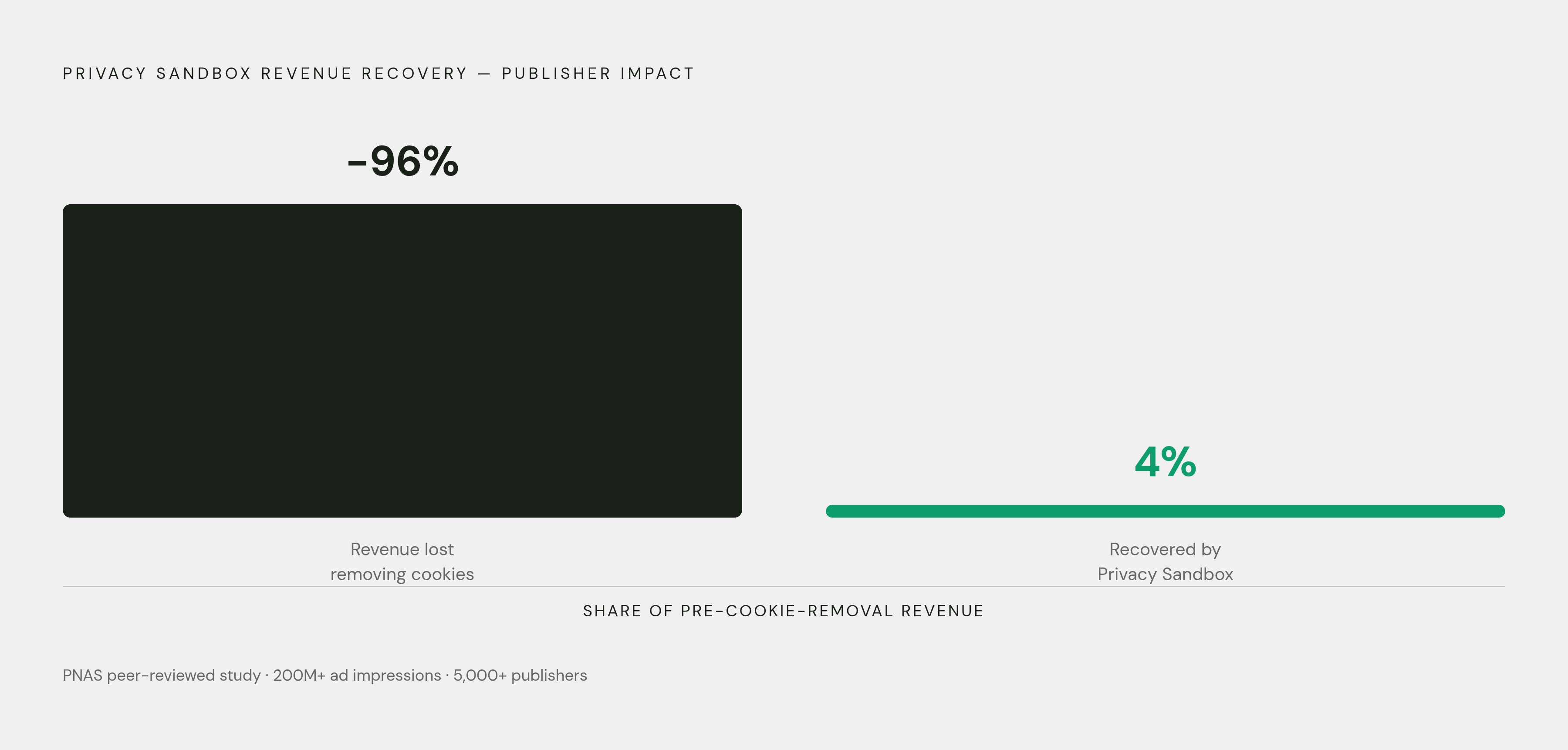
The revenue impact is now measured, not predicted. A peer-reviewed field experiment published in PNAS in 2026, covering more than 200 million ad impressions across more than 5,000 publishers worldwide, found that removing third-party cookies reduced publisher revenue substantially. Measured against Google's Privacy Sandbox as an alternative, the replacement recovered only about 4% of the lost revenue. That is a structural finding about how much value the old infrastructure was carrying.
AI-driven search compression sits on top of these pressures. Referral traffic from search engines is declining, and publishers who depend on anonymous visitors arriving from Google have fewer high-value users to monetize. The publishers who are recalibrating are doing so toward identity infrastructures that do not depend on search engines delivering readers at all.
What zero-party data is and why it is different from behavioral first-party data
Zero-party data is not a synonym for first-party data, and the distinction matters commercially because declared intent is worth more to advertisers than inferred behavior. Survey responses, poll results, preference-center inputs, quiz responses, stated topic interests, purchase intent declarations. The user made a choice to tell the publisher something.
First-party data works differently. First-party data tells publishers what users do. Zero-party data tells them why.
The hierarchy is visible in a single example. If a user reads travel articles, first-party behavioral data signals casual interest. If a user selects luxury travel in a preference center, that is explicit commercial intent. Both signals are real, but they are not the same thing, and advertisers do not price them the same way.
The two types complement rather than replace each other. Combined, they give publishers a picture of their audience that neither can supply alone, and that combination is what the revenue models in this piece are built on. Because zero-party data is collected directly from users with their knowledge and participation, it is typically more accurate and more readily usable within privacy regulations than inferred or brokered signals.
The CPM premium model: how declared intent converts audience clarity into advertiser pricing power
Declared-intent segments command measurable CPM premiums because they eliminate the ambiguity that depresses programmatic pricing. Zero-party data converts audience ambiguity into explicit intent, and advertisers pay more for that. Publishers who master this transition capture CPM premiums over traditional targeting methods, and those premiums are structural, not incidental.
The mechanism shows up in the mechanics of private marketplaces. Private marketplace deals with authenticated audience signals deliver meaningfully higher CPMs and substantially higher viewability rates compared to open exchange. An advertiser who knows they are reaching readers who have stated a relevant preference is buying certainty, and certainty commands a higher price.
The economics are highly leveraged for publishers with concentrated engaged audiences. INMA benchmarks show a small fraction of users drives a disproportionate share of pageviews, and one European national publisher derives the vast majority of its total revenue from a tiny fraction of its users. Convert even a portion of anonymous visitors to identified, preference-sharing users and the revenue needle moves sharply, because those are the users advertisers are competing to reach.
The cases confirm the mechanism. Bloomberg, after shifting away from third-party programmatic approaches, saw a meaningful uplift in advertising CPMs. Owned, consented data translated directly into commercial resilience.
Packaging declared data into direct deals: newsletter sponsorships, local intent programs, and subscription conversion
The CPM premium model runs through programmatic and private marketplace pipes. Direct deals are a different sales motion, and zero-party data makes the packaging more defensible because the audience quality is verifiable rather than claimed. The same declared signals that lift CPMs become the foundation of packages sold through a relationship rather than an auction.
Segmented newsletter sponsorships become a distinct commercial product when subscribers have explicitly stated their topic interests. Local intent programs work on the same principle. Where audiences have declared zip codes, purchase intent, or category preferences, local and regional publishers can compete on precision rather than volume against national platforms.
Category-specific advertising packages built on declared signals produce higher campaign performance and stronger advertiser outcomes. The LMII playbook of 2026 treats this not as a technology initiative but as a strategic capability. The data enables the packaging, but the commercial skill is building the package the advertiser cannot buy elsewhere.
Zero-party data also feeds subscription conversion, though this is a supporting model rather than the main one. When publishers know which benefits a user cares about most, declared through preference centers or quiz interactions, they can personalize subscription offers to match stated priorities. That improves conversion rates compared to one-size offer walls.
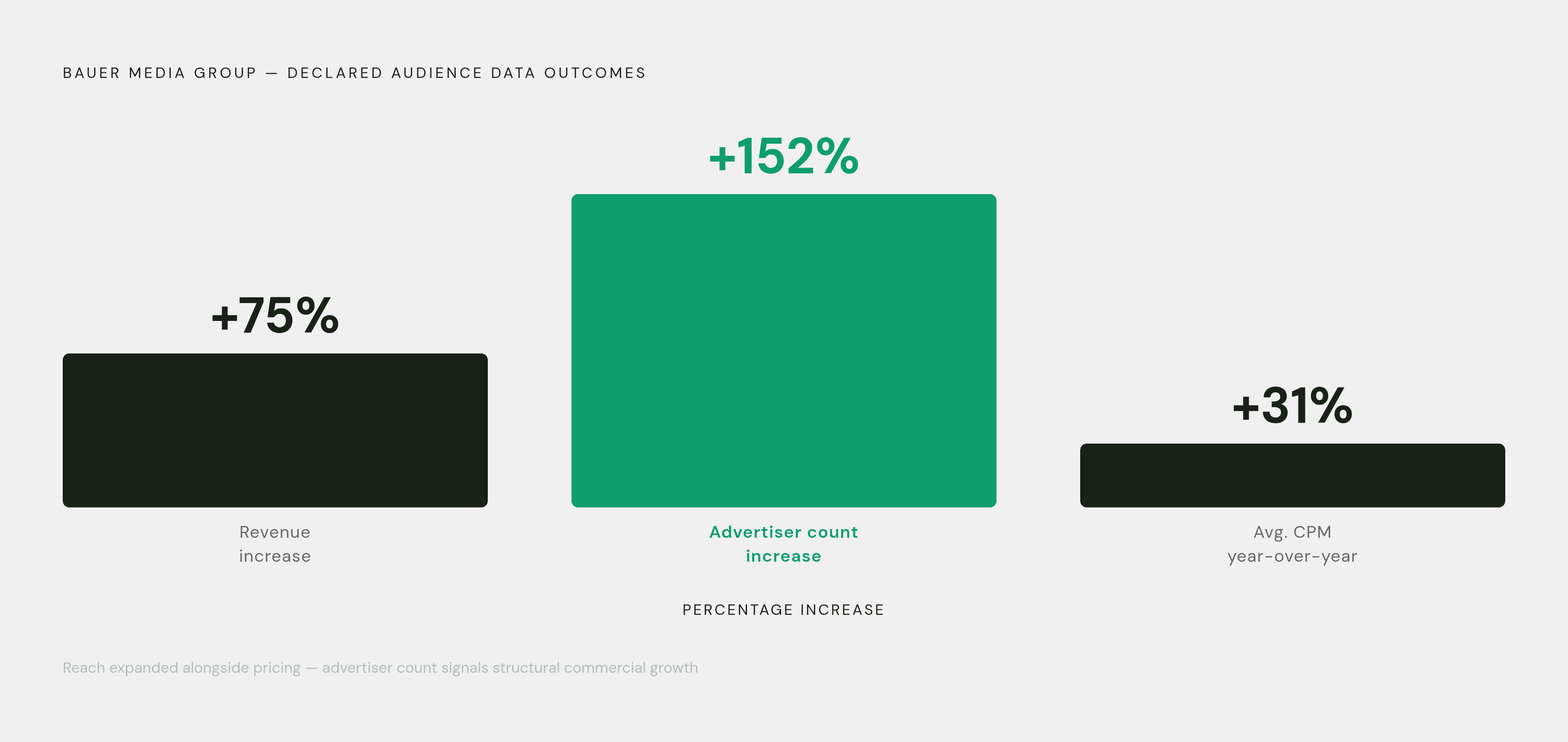
Bauer Media Group is the strongest evidence here. The company reports a 75% increase in revenue, a 152% increase in advertiser count, and a 31% year-over-year increase in average CPM, supported by audience and campaign insights from a scaled first-party data approach across its publishing portfolio. Those are not marginal gains. They are the result of treating declared audience data as the foundation of a commercial strategy rather than a byproduct of ad operations.
Data clean rooms as a publisher revenue layer: how the architecture works and what it pays
Publishers are using clean rooms as their main way to monetize authenticated audience data with major advertisers. They give both parties what they need without either exposing raw records, and that privacy guarantee is what makes the model viable at all. The architecture is straightforward. In the more commercially interesting audience activation model, the clean room computes a lookalike or seed-expanded audience segment, delivers it to the publisher for activation on the publisher's own inventory, and the publisher sells against that audience at a CPM premium. The advertiser gets addressable reach without the publisher surrendering its audience.
Publishers are the fastest-growing clean room end-user cohort, investing mainly to monetize first-party and zero-party audience data while reclaiming the addressable premium that third-party cookie-based targeting networks used to extract. This is not a model reserved for the largest players. Mid-market publishers, podcast networks, niche media properties, digital-native content platforms, are generating meaningful annual incremental revenue through clean room-enabled data monetization.
The New York Times ran its first-ever data clean room deal in Q4 2025, using Decentriq to match first-party subscriber data against a major global wealth manager's customer records inside an encrypted environment. The results included a substantial uplift in Quality Visit Rate, a large international CTR lift, and a meaningful U.S. uplift from a lookalike segment. The campaign also revealed that a quarter of the bank's customers are Times readers, a finding that demonstrates the unique value of an authenticated subscriber base to financial advertisers.
IAB Tech Lab standardization is lowering the operational barrier. IAB Tech Lab finalized PAIR, the Publisher Advertiser Identity Reconciliation protocol, version 1.1 in July 2025, using commutative cryptography to match encrypted join keys. ADMaP, the Attribution Data Matching Protocol, version 1.0 followed in February 2025. These two interoperability standards now underpin cross-platform data matching, so the technical foundation for clean room deals is settled and accessible rather than bespoke.
Data and insight licensing: when publishers sell analytical outputs rather than ad inventory
Data and insight licensing converts a publisher's declared audience data into a revenue stream that is independent of ad impressions. The asset being sold is the analytical output, not the placement. Within the clean room market, data monetization applications are the smallest category but the fastest-growing one. Category preferences, declared intent distributions, segment composition. The buyer is a brand, an agency, or a research organization.
This model suits niche and specialist publishers whose audiences are hard for advertisers to find elsewhere. The governance requirement is structural. Zero-party data, collected through explicit preference flows, has a clear advantage over inferred behavioral data on exactly these points.
Forbes built an internal data infrastructure called ForbesOne for collecting and analyzing first-party user data using machine learning. The platform creates audience segments across more than 600 data points and enables audience licensing at scale, with a reach exceeding 135 million monthly. That is what it looks like when a publisher industrializes the transition from editorial audience to licensed data asset.
The scale problem: why zero-party data is not a complete replacement for behavioral signals
Zero-party data's greatest commercial strength is also the constraint on how much of it any publisher can collect. It is voluntarily declared, which means it requires active participation. Not every user is willing to share preferences or personal information, and zero-party data collection is typically less scalable than behavioral tracking because it requires consent and action rather than passive observation.
Publishers are more likely to collect declared data from highly engaged users than from their entire audience. First-party behavioral data remains the backbone of scalable monetization. Zero-party data functions as the premium layer on top of it, not as a standalone replacement.
Collection design compounds the scale problem. A long survey on top of a cold signup flow feels like work, especially when the user has not yet seen the value exchange. This pushes publishers toward progressive, incremental collection tied to specific content interactions, polls, quizzes, preference prompts, rather than registration-gate surveys.
The structural objections run deeper than collection fatigue. The major platforms, Google, Amazon, Meta, and cloud infrastructure providers, accrue significant revenue gains from clean room and CDP infrastructure. Each new integration raises the question of whether publishers are building durable data assets or deepening platform dependency.
How publishers build a durable zero-party data operation: collection rules, value exchange, and governance
A durable zero-party data program is a strategic capability, not a technology project. The data quality and the commercial yield both depend on how the collection is designed and governed, not just on which tools are in place. If collection is tied to content interactions, it addresses the scale problem more effectively than registration-gate surveys. Start with one or two high-signal questions relevant to the content context. Expand only after demonstrating to the user that their preferences are being used to improve their experience.
Governance is not a separate compliance step. It is what makes the data commercially usable. The governance standard and the commercial standard are the same standard.
Publishers adopting a privacy by design approach, processing data locally, avoiding unnecessary transfer of personally identifiable information into the bid stream, relying on first-party IDs, are better positioned in GDPR-strict markets. A first-party and zero-party data strategy requires alignment across product, editorial, subscription management, and technical teams. Treating it as an ad-ops initiative rather than a cross-functional strategic capability is a common failure mode, and it is a costly one.
Why adoption momentum favors publishers who build this infrastructure now
Publisher adoption of first-party and zero-party data infrastructure is accelerating, which means the premium for being early is real but the window for differentiation is closing. In Q1 2025, nearly three-quarters of publishers, 71%, said first-party data plays the most significant role in generating positive ad revenue outcomes, up from 64% the prior year. The trend line is steep and consistent.
The investment is no longer experimental. The technical standards are now settled, with PAIR v1.1 finalized in July 2025 and ADMaP v1.0 in February 2025. Publishers who have not yet built authenticated audience infrastructure will find it increasingly difficult to participate in the clean room deals that major advertisers are standardizing on.
AI-driven traffic decline from search engines is compressing the window further. Publishers who depend on anonymous referral traffic for the bulk of their ad inventory have fewer high-value users to monetize. Publishers with identity infrastructure and declared-data programs are already recalibrating to a model that does not depend on Google sending them readers.
The publishers who treat zero-party data governance as a competitive advantage, not a compliance cost, are the ones building the authenticated, consent-grounded audience assets that regulators can accept and that advertisers increasingly require. The organizations that wait are not avoiding the investment. They are deferring it until the premium has been captured by competitors who moved earlier.