Email Deliverability Gains From Consent-Based List Hygiene
Confirming subscriber intent at signup lifts inbox placement by nearly 40 percentage points.

Getting a message onto someone's server is not the same as getting it into their inbox. That gap between "delivered" and "seen" is where most email marketing budgets quietly vanish, and consent-based list hygiene is the biggest lever for closing it. Unspam.email's 2025 corpus analysis found that only 60% of sent emails reached a visible mailbox location. The rest hit spam or got rejected at the SMTP level before a human ever had a chance to see them. Consent is how that gap closes, and most senders are working the wrong end of the problem.
How mailbox providers decide inbox placement in 2026
Three companies run consumer email now. Gmail, Yahoo, and Microsoft cover something like 90% of the world's inboxes between them, and their spam filtering rules aren't policy suggestions anymore. They're the standard everyone else builds around.
That standard got sharper fast, and most senders are still catching up. In February 2024, Gmail and Yahoo started requiring SPF, DKIM, and DMARC for anyone sending more than 5,000 emails a day, along with one-click unsubscribe and a spam complaint rate under 0.1% (enforcement kicks in past 0.3%). By mid-2024, one-click unsubscribe was required to live in the message header itself. Then in November 2025, Gmail changed the penalty. Instead of soft-deferring non-compliant mail into spam, it started issuing hard 5xx rejections: the mail doesn't get delivered, full stop. Microsoft followed in May 2025, applying the same rejection rule to Outlook, Hotmail, and Live.com for senders over that same 5,000-a-day mark.
Most senders treat authentication as the finish line, when it's barely the entry fee. Only 7.6% of B2B senders actually enforce DMARC. Record presence has climbed past 75% among Fortune 500 domains, which sounds like progress until you notice that only about 35% of those records are set to p=reject, the enforcement level that actually earns the deliverability benefit. Everyone's publishing the record. Almost nobody's turning it on. And even the senders who do everything right on paper still get burned: Unspam.email found that fully authenticated mail, SPF, DKIM, and DMARC all passing, still landed in spam more than 30% of the time. Authentication gets a message past the front door. What happens after that comes down to engagement signals, and engagement signals come from the list itself.
Why lists decay over time and its effect on sender reputation
Lists don't sit still, ever. ZeroBounce's Email List Decay Report found at least 23% of all emails checked were invalid or risky, a rough number to sit with if a list hasn't been touched in a while.
Decay runs a steady monthly bleed, somewhere around 2 to 3% of valid addresses gone every month, compounding to 22 to 30% lost across a year if nobody does anything about it. Tech-sector audiences, where job turnover runs high, lose 30 to 40% annually. That's a third of a list turned to dead weight in twelve months, not a rounding error.
Most of that decay is just people living their lives. Something like 70.8% of business contacts go through some kind of change within a year: a new job title in 65.8% of cases, an entirely new email address in 37.3%. Mailbox providers then put a hard deadline on what's left. Yahoo deactivates inactive mailboxes after 12 months and deletes the account outright after 24. Gmail waits 24 months before deactivation. An address that was perfectly valid the day someone signed up can turn into a hard bounce, or worse, a spam trap, right on schedule. Most senders find out the bounce rate spiked long after the damage already showed up in their sender score.
What consent structures do to a list's composition
Reactive cleaning and consent-based hygiene solve two different problems, and mixing them up is where a lot of deliverability strategy falls apart. Reactive cleaning removes bad addresses after they've already done damage: after the bounce, after the complaint. Consent structures stop those addresses from landing on the list in the first place, or from staying there once they've gone stale. That distinction is the whole argument. Everything else in this piece just proves it.
Three mechanisms do most of the work. Double opt-in at signup verifies the address, kills typos and disposable addresses before the first send, blocks bot submissions, and filters for actual intent. Preference centers let subscribers choose their own frequency and content type, cutting down on the mismatched sends that generate complaints even from addresses that are completely valid. A clear, low-friction unsubscribe path gives disengaged people an exit that doesn't run through the spam button.
Consent is not a one-time checkbox, and treating it as one is why so many lists rot from the inside. It's an ongoing signal. A subscriber who actively confirmed their address, picked their own preferences, and keeps opening mail is the kind of contact mailbox providers now use to score sender reputation. Opting in and generating a good reputation signal aren't two separate events that happen to correlate, they're mechanically the same thing.
A fourth practice rounds the set out. A sunset policy is a systematic, ongoing process, not a one-off cleanup, that steps down sends to disengaged contacts, tries to win them back, then moves the non-responders into suppression. Adoption remains low, dead last on the list among the practices that actually work.
Double opt-in's direct effect on bounce rates and inbox placement
Adoption here is close to a coin flip, and that's the wrong ratio for something this cheap to run. Nearly 40% of senders use double opt-in, 47.6% don't, and 12.7% aren't even sure what their own signup process does. Sitting on the fence here costs real placement.
The gap between those groups makes the case on its own. Double opt-in lists often clear 97% inbox placement. Single opt-in lists tend to average closer to the lower end of industry-wide placement benchmarks. One extra confirmation email at signup separates a campaign that mostly lands from one that mostly doesn't.
Engagement follows the same split downstream. In some industries, open rates and click-through rates for double opt-in lists run roughly double those of single opt-in lists.
Geography backs this up in a way that's hard to argue with. Europe, where GDPR legally requires opt-in consent, posts 91.1% inbox placement overall, and Germany alone hits 97.5%. The US, running on an opt-out default, is 85%. Asia Pacific, without equivalent consent law, is 87.9%. The regions with the strictest consent requirements post the best placement, and that's the same mechanism from the double opt-in numbers, just visible at population scale.
How preference centers and segmentation reduce complaint rates
Gmail's spam complaint ceiling is 0.3%. Industry best practice pushes well under that, staying below 0.1%, ideally closer to 0.05%. Those thresholds trigger enforcement, so treating 0.3% as a safe target instead of a cliff edge is a mistake senders keep making.
Complaints don't come from nowhere. Spam filtering ranks as the single biggest barrier to reaching consumers for 60.3% of businesses, low engagement accounts for another 16.4%, and poor data quality makes up 9%. That 16.4% engagement number is mostly a preference problem wearing a disguise: people getting content they never asked for, at a frequency they never agreed to.
A preference center fixes this mechanically, not philosophically. Let a subscriber choose email type, topic, and frequency up front, and someone who only gets what they actually asked for is far less likely to hit "report spam," even in the months they've stopped reading closely.
A subscriber who unsubscribes through a visible, one-click header link generates zero complaints, full stop. One who can't find the link, or has to click through three pages to use it, reaches for the spam button instead. One-click unsubscribe technically raises the measured unsubscribe rate, and that's exactly the point: every clean exit is a complaint that never happened.
Sunset policies as the consent mechanism that keeps clean lists clean
Most senders use "sunset policy" and "list cleaning" as if they're the same thing, and that mix-up costs them. A sunset policy runs automated and ongoing: it steps down sending frequency to disengaged contacts, attempts re-engagement, then suppresses whoever still doesn't respond. Suppression isn't deletion. The record stays intact, but the deliverability risk disappears.
This is the least-adopted of the three practices, by a wide margin. A clear majority of senders have no sunset policy running at all, and a meaningful share don't even know whether they do. That gap is the single easiest fix in this entire piece, and almost nobody's taken it.
A common trigger window is several months of zero engagement before a contact moves to suppression, adjusted for how often the sender normally mails and what kind of content goes out.
Where it's been tried, the results are hard to argue with. BuzzFeed cut a large chunk of its subscriber list and saw engagement rates triple afterward. Senders who apply consistent engagement-based suppression tend to see open rates well above the industry average. Cutting names is addition by subtraction on a list like that, and the senders still resisting sunset policies are the ones watching their placement slide without ever figuring out why.
The compounding effect when all three consent practices run together
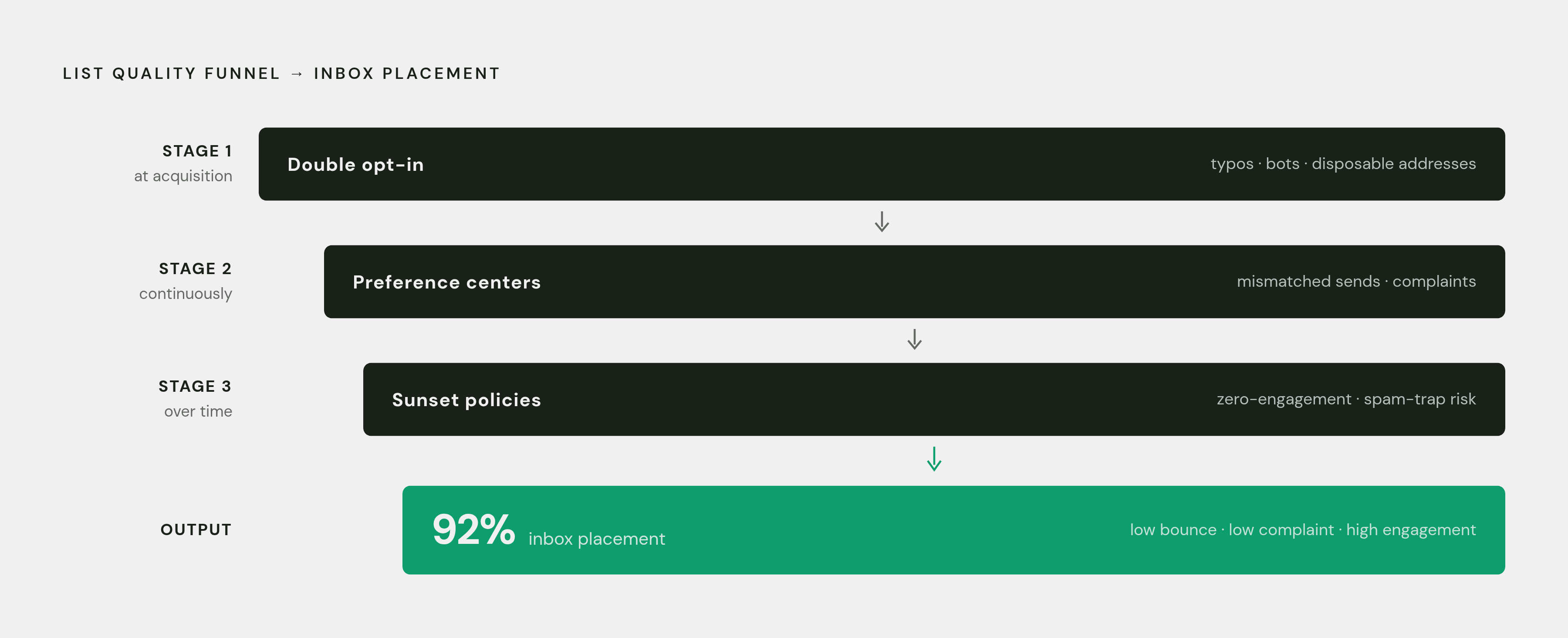
The argument for this part of the story is structural, resting on the layered filtering of double opt-in, preference centers, and sunset policies. Double opt-in filters at the moment of acquisition. Preference centers filter continuously, based on relevance. Sunset policies filter over time, based on engagement. Each one catches a category of risk the other two can't touch, so running only one or two leaves a gap the third would have closed. Skipping any of them isn't a shortcut, it's a hole left open on purpose.
Stacking those three outputs produces the exact pattern mailbox providers are now built to detect: low bounce rate from double opt-in, low complaint rate from the preference center, high engagement from the sunset policy. Together, that combination drives sender reputation scoring in 2026, and it is essential infrastructure now. It's the baseline.
Validity's benchmark data shows what a strong reputation is worth: around 92% inbox placement. A poor sender reputation score can drop placement dramatically, well below the industry average. That's a cliff, not a slope, and senders who treat list hygiene as optional tend to find it the hard way.
The same three practices, done properly, leave behind a documented consent trail: timestamps, source URLs, the exact opt-in language shown, preference selections, engagement history. That record happens to satisfy GDPR's explicit consent requirement and CAN-SPAM's opt-out documentation requirement, all at once. Compliance paperwork and deliverability infrastructure turn out to be the same file, kept for two reasons that never needed to be separate.