Consented Audience Size and Paid Social ROAS
Smaller consented audiences compress ROAS faster as high-intent prospects exhaust.

Consented audience size is a performance variable. It determines how much signal a platform has to optimize bids against, how fast a campaign burns through its best prospects, and where ROAS settles once the easy gains run out.
Audience Signal Volume and Platform Optimization
Meta and similar platforms decide who sees an ad with a formula built from bid, predicted action rate, and ad quality score. That formula needs data to run. The size and quality of the signal pool behind a campaign shapes how well the platform can estimate who's likely to convert, long before targeting choices or creative come into play.
Delivery starts with the highest-intent users inside whatever audience a campaign defines: an interest segment, a lookalike, or a custom upload. The platform works outward from there. It needs enough matched records and conversion events to learn the pattern of who buys. Below a certain volume, the algorithm can't reliably finish learning, and performance stays erratic rather than settling into a predictable range.
As a campaign runs long enough in the same pool, the pattern becomes visible in the numbers. Each new impression reaches someone slightly less likely to convert than the last, and the cost of reaching them climbs as the pool thins out. That's the mechanism behind ROAS compression over time: not a platform glitch, but the predictable result of a finite pool getting worked harder. Auction dynamics make it worse. More advertisers bidding on the same limited inventory pushes CPMs up even when conversion rates hold steady, so a signal-poor impression late in a campaign costs more than a signal-rich one did at launch.
Audience pool size sets the ceiling on how long a campaign can hold its early efficiency. That makes the pool a variable worth managing with the same discipline applied to bids and creative.
Consent Frameworks as the Upstream Constraint on Audience Size
A brand's CRM list and its consent-valid advertising audience used to be close to the same number. They're pulling apart now, and the space between them is audience the platform never sees.
Apple's App Tracking Transparency cut the share of mobile users whose behavior can be observed for audience-building, which shrinks the signal available on the platform side before a brand even uploads its own data. That's a real constraint, but it's not the main story.
The bigger shift is regulatory, and it's enforced at the platform level rather than left to individual brands to interpret. Under EU rules, visitors who haven't given consent are excluded from custom audiences. Google's Consent Mode V2 framework states that when a user withholds ad personalization consent, that user is excluded from remarketing lists and personalized ad targeting. If advertisers run EU audiences without Consent Mode V2 in place, they lose access to audience-based remarketing. This is a structural reach limit built into the platforms themselves. A brand without solid consent-collection infrastructure can't buy its way around it with a higher bid or a better ad.
CRM decay adds a second drag on top of the consent gap. Records go stale. People change emails, switch phones, abandon old accounts. Match rates erode even among users who agreed to being tracked. The effective audience shrinks from two directions at once: consent that was never given, and consent that's technically still valid but tied to a record the platform can no longer resolve.
Two brands can carry identical CRM list sizes, but if one collected and maintained consent more systematically, their matchable audiences end up wildly different.
Match rate as the translation layer between consented records and active ad audiences
Consent determines who's eligible to be targeted. Match rate determines how much of that eligible group the platform can actually find and activate, which makes it the most actionable number in this whole chain.
Match rate is the share of uploaded, consent-valid records that resolve to a real, active user on the platform. But a massive CRM file full of properly consented contacts still delivers weak signal if the match rate is low. Size alone means nothing without resolution.
Record quality drives that resolution rate directly. Email formatting, phone number structure, address completeness: these aren't back-office details, they're performance inputs. Consent infrastructure and data hygiene function as one system, not two separate workstreams handled by different teams.
Server-side tracking through Meta's Conversions API (CAPI) recovers signal that browser restrictions and ATT have cut off. CAPI passes conversion events directly from a brand's server rather than depending on a browser-based pixel firing correctly, which restores some of the event data the optimization engine needs to bid well. CAPI does not expand the pool of people available to target. It recovers more complete signal, but only for users already inside the consented, matched audience a brand already holds. Confusing the two leads teams to expect audience growth from a tool that only sharpens the signal on the audience they've already got.
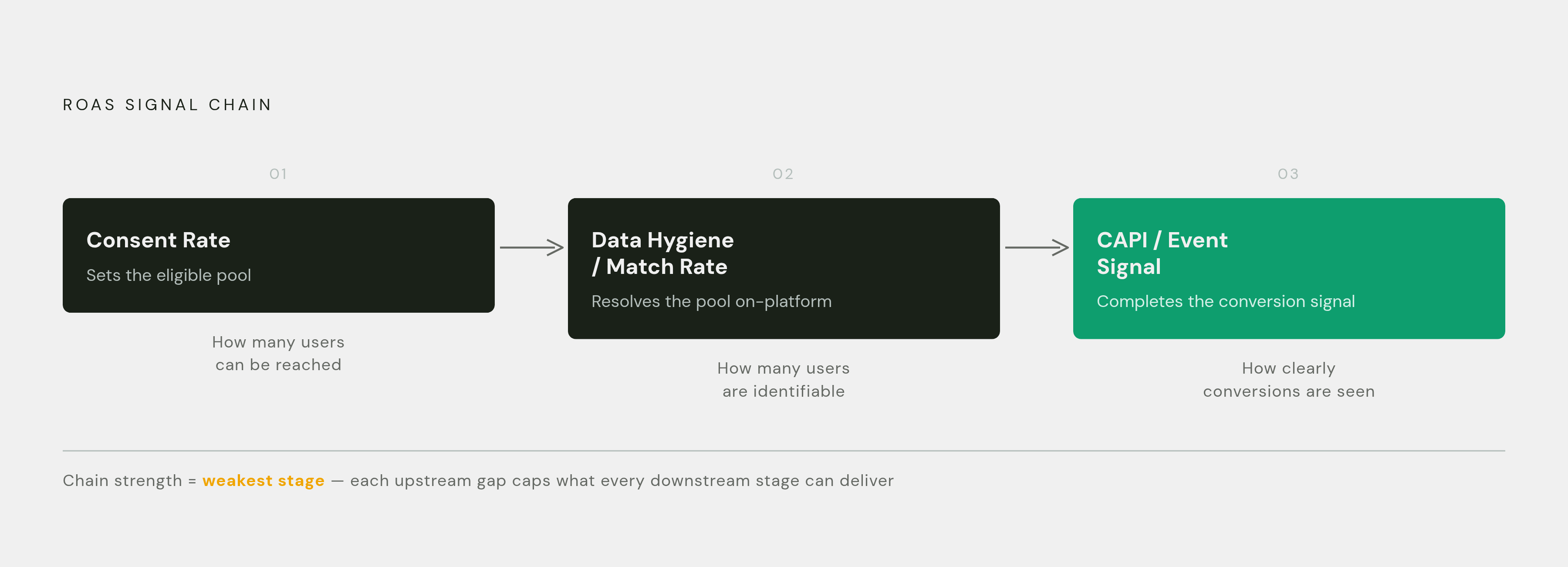
Three separate mechanisms govern the whole chain. Consent rate governs how large the eligible pool can be. Data hygiene governs how much of that pool actually resolves into a usable match. CAPI governs how complete the event signal is for the users who do resolve. ROAS depends on all three running well together, and weakness in any one limits what the other two can deliver.
What happens to ROAS as a consented audience pool shrinks relative to campaign spend
If a consented pool is too small for the spend running against it, it gets burned through fast. Once the high-intent users inside it are exhausted, every additional dollar buys a worse return instead of more of the same.
Early in a campaign, delivery concentrates on the best-matched, highest-intent users the platform can find. ROAS looks strong during this phase, and that strength tempts a team to scale spend. Scaling without growing the consented pool just speeds up the depletion. The algorithm has nowhere else to go but further out into lower-probability prospects within the same limited segment.
Automated campaign structures built around broad, algorithm-driven targeting can mask this for a while. Blended reporting can hold steady even as the underlying prospecting efficiency falls apart, because retargeting performance props up the average. It's the reason some advertisers don't notice the depletion until spend has already scaled past the point where it's cheap to fix.
Retargeting pools deplete by design, since they're built from people who've already interacted with the brand. Without steady prospecting to feed new people into that pool, retargeting audiences shrink on their own, frequency climbs on the remaining users, and performance drops regardless of how clean the consent file behind it is. Retargeting still works as a tactic, but it depends on prospecting to keep its pool replenished.
The ceiling this creates is structural. No amount of new creative fixes a campaign that has simply run out of qualified, matchable people to show that creative to.
Small, High-Consent Audiences vs. Larger Uncleaned Lists
A small, fully consented, precisely matched audience routinely beats a larger but messy one on cost per result. A cleaner signal lets the platform optimize with more confidence, which shows up as lower cost-per-acquisition and stronger ROAS in a campaign's early phase.
That edge is most visible in prospecting, where the uploaded audience acts as a seed for lookalike modeling. A high-quality seed produces a higher-quality lookalike, which extends the value of a clean consented list well past its raw record count.
The edge has a limit. If a pool is small enough to deplete quickly, too small to produce a statistically solid lookalike, or too small to let the algorithm finish its learning phase, it becomes a growth ceiling instead of an advantage.
The strongest challenge to this whole argument is that creative now drives more of the variation in ROAS than audience configuration does. That challenge has real merit. Creative fatigue on a small audience worsens the depletion, since the same small group of people sees the same ad more often and tunes it out faster. Strong creative paired with a large, consented pool holds up longer, because the algorithm has both a clean signal and enough inventory to keep optimizing against it. Audience size and creative quality aren't competing for credit here. A larger consented pool gives strong creative more room to work before fatigue sets in, and when the audience is small, frequency climbs fast, so fatigue does more damage.
Consent Rate as a Growth Input
If marketers track consent rate and match rate alongside audience pool size as standing campaign inputs, not just numbers pulled out for a legal review, they can catch audience depletion while there's still time to fix it.
The standard reporting stack, ROAS, CPA, CPM, frequency, tells a team what already happened. Consent rate and pool size are leading indicators. They explain why performance moved and give an early read on where it's heading next, raising flags before the damage appears in the headline numbers.
Splitting Meta ROAS by funnel stage, prospecting against retargeting, makes the consent-pool dynamic visible instead of hidden inside a blended average. Declining prospecting ROAS alongside a blended ROAS that still looks fine is the clearest early sign that the consented audience is too small for the spend running against it. That pattern gets misread as a creative problem far more often than it should.
Attribution model choice compounds the misread. Last-click attribution systematically under-credits prospecting and over-credits retargeting, which makes a shrinking consented pool look perfectly adequate right up until it isn't. A multi-touch or data-driven model gives a truer read on what prospecting spend, and the audience behind it, is actually contributing.
Measuring consent rate at the point of collection, not just at the moment a list gets uploaded for a campaign, reveals the gap between CRM size and matchable pool size while campaign planning is still underway. Caught there, it's a planning adjustment. Caught mid-campaign, it's a budget already spent against a pool that couldn't support it. Consent rate belongs in the same planning conversation as budget allocation and audience strategy. Scaling spend without a consented pool sized to match it accelerates ROAS compression, whether that's the intended outcome or not.
Building consent-collection infrastructure as a paid social performance asset
The brands sustaining strong ROAS at scale are the ones holding the largest pools of consent-valid, accurately matched, regularly refreshed first-party records, because that pool is what gives the platform enough signal to keep bidding efficiently as spend grows.
Consent collection at every point a customer touches the brand, the website, checkout, email signup, CRM onboarding, directly grows the matchable audience available for paid social. That makes nearly every product and growth decision that touches the customer relationship a paid social audience decision too, whether the team building it thinks of it that way or not.
Data hygiene and consent freshness need ongoing maintenance. Records decay, consent lapses, devices and emails change, and match rates fall continuously unless someone is actively tending the file. A consent file left alone shrinks in effective size even while the raw record count on the dashboard stays the same.
Server-side tracking through CAPI, run alongside a well-maintained consented audience, restores the signal completeness that browser restrictions and ATT took away. When a large consented pool pairs with complete event signal, the optimization engine can keep bidding efficiently as spend scales up.
In European markets, platform-level enforcement makes this a condition for reach, not an optional add-on. Access to behaviorally targetable, fully personalized audiences runs directly through consent collection there. That makes consent infrastructure a direct input into total addressable reach.
The teams building this now, with ownership, measurement, and a real refresh cycle, are putting distance between themselves and teams still treating consent as a compliance task to revisit someday. That distance compounds with every campaign cycle: one pool keeps growing, the other quietly erodes.