Customer Data Platform Match Rates and Consent Coverage
High match rates mean little without documented consent for each activation purpose.

A CDP's match rate tells a marketer how many imported records found a home in the platform's identity graph. It says nothing about how many of those matched people actually agreed to be reached for the purpose the campaign has in mind. That gap, between "matched" and "consented," is where a lot of activation plans quietly fall apart, because match rate lives on the marketing dashboard while consent lives on the legal team's spreadsheet, and the two rarely talk. Treating consent coverage as the hidden variable, not a footnote, keeps a high match rate from being an automatic win. It becomes a number that has to earn its keep.
What match rate measures, and what the formula leaves out
The formula itself is simple. Match rate equals matched IDs divided by valid imported IDs, times 100. "Valid" Here, the identifiers, email, phone, mobile ad ID, postal address, survived cleaning and deduplication before matching even started, Donutz Digital notes.
What that number captures is correspondence. Did the identifier show up somewhere in the platform's graph? Correspondence is all that number captures. It doesn't say whether the person behind the identifier gave permission for the use case at hand, whether that permission is still valid, or whether the match itself was found deterministically (exact identifier match) or probabilistically (a statistical guess based on device or behavior signals). None of that is baked into the math.
Benchmarks show how wide the range already is before consent even enters the picture. Meta runs 50 to 80% when email and phone are combined, and 35 to 60% on email alone, Donutz Digital reports. Google Ads runs 10 to 25% across typical use cases, Donutz Digital reports. So "a good match rate" depends entirely on channel and data type, before anyone asks whether the data has consent behind it.
Even a near-perfect result doesn't settle it. LiveRamp, in a Comscore CustomIQ analysis using full PII and complete address data, hit a 99.5% match rate, about as clean as identity resolution gets. That's about as clean as identity resolution gets. But 99.5% only says how many identifiers resolved to a known profile. It says nothing about how many of those people said yes to being reached this way.
The number that actually matters for a campaign is consented matched profiles. It's consented matched profiles. And that smaller number is set by consent coverage, not by how good the identity resolution engine is.
How consent coverage shrinks the activatable pool before a campaign
Consent works as a pre-filter, not a cleanup step applied after the fact. Under GDPR, ePrivacy, and the growing list of state privacy laws in one country, platforms and CDPs are supposed to drop records that lack a clear legal basis before matching even runs, Donutz Digital notes. The shrinkage happens upstream, quietly, before anyone sees a match rate on a report.
That means a match rate calculated against a full CRM export overstates real reach whenever that CRM contains records without documented consent for the specific activation purpose, whether that's advertising, profiling, or cross-channel targeting.
Three kinds of profiles end up matched but functionally unusable:
- Consent that's expired, say, an opt-in collected before a preference center got updated
- Consent given for one purpose (transactional email) but not the one a campaign actually needs (paid media retargeting)
- Profiles under an opt-out or deletion request that hasn't yet propagated to every downstream system holding a copy
Data freshness makes this worse in a specific, mechanical way. A weekly upload beats a quarterly one for match rate, since fresher data resolves better, Donutz Digital reports. The same logic applies to consent records, but teams rarely apply it there. If consent signals refresh on a different schedule than identifiers do, "matched" and "consented to be reached" drift apart, which can go unnoticed until it causes real problems.
The real activatable audience is the overlap between matched profiles and consented profiles. Most teams can only tell you the size of the first group. There's no single reliable industry figure for average consent coverage across CDP deployments, and any number claiming otherwise should be treated with suspicion. What's consistent, qualitatively, is that the second number is almost always smaller, sometimes by a wide margin, and almost nobody reports it next to match rate.
The regulatory landscape that makes unconsented match rates an enforcement risk, not just a governance gap
This isn't an abstract governance concern anymore. As of January 2025, 144 countries had national data privacy laws on the books, covering roughly 82% of the world's population. Running a CDP as if consent rules are optional, or someone else's problem, isn't a viable posture for any organization operating across borders.
That country's picture is accelerating on its own. Twenty-four states have passed comprehensive consumer privacy laws, with 20 in effect as of July 2026. Three more, Indiana, Kentucky, and Rhode Island, took effect January 1, 2026, and all three require opt-in consent for sensitive data processing, backed by civil penalties.
Cure periods, the grace windows regulators used to give companies to fix violations before penalizing them, are disappearing fast. Delaware's 60-day cure period ended December 31, 2025. Montana's ended October 1, 2025, after SB 297 eliminated it early, ahead of its original April 1, 2026 sunset date. New Jersey's expired in mid-2026. States that used to warn first are now moving straight to enforcement.
California raised the bar further. Starting January 1, 2026, the CCPA requires that opt-out signals, including Global Privacy Control browser signals, be processed and honored. Enforcement actions against PlayOn Sports, Disney, and Healthline made the point concretely: a browser-level opt-out signal now gets audited the same way a traditional opt-out form does. Ignoring it isn't a technical oversight, it's a violation.
GDPR enforcement has already run past €5.8 billion in cumulative fines as of January 2025, and global privacy penalties over recent years have accumulated into the billions. The record-setting €1.2 billion Meta fine, tied to cross-border data transfer failures, shows what unmanaged data flow looks like once regulators decide to act. Regulatory actions have targeted platforms over cookie consent failures and child data processed without opt-in. Consent failures at the ad-tech and CDP layer aren't theoretical enforcement targets. They're the ones actually getting hit.
A match rate built on profiles without documented consent counts as potential exposure. It's potential exposure, and regulators have started pricing that exposure in real dollar figures.
What data hygiene gets right and misses in improving match rates
Data quality genuinely moves match rate. CRM instances with well-maintained contact records generally match better than those with looser governance, a pattern consistent across identity resolution assessments. Better-maintained CRM environments consistently outperformed less-governed ones on this measure.
The standard hygiene playbook runs through a familiar checklist, Donutz Digital notes: deduplicate by primary key, normalize formats, stack multiple identifiers (email plus phone for B2C, professional email plus domain plus title for B2B), strip known bounces, and automate upload cadence so data doesn't go stale.
None of that touches consent. A well-formatted email address with no consent record attached is cleaner, sure, but it isn't any more activatable than before. Stacking identifiers, adding a phone number to an email match, raises match rate on paper. But if that phone number was collected without consent for ad targeting specifically, the extra reach is unusable in any regulated market. Deduplication cleans up duplicate rows, but it does nothing to resolve which version of a record actually holds the most current consent signal.
Scale makes this messier. Dataintelo finds the average enterprise manages customer data across 12 to 18 different systems. A consent signal captured in one system, a preference center update, say, rarely makes it automatically to every other system downstream that's holding a matching identifier.
Data hygiene improves match rate. Consent hygiene determines how much of that match rate can actually be used. Teams that invest heavily in one while ignoring the other end up optimizing a ceiling they can't reach.
Architectural choices in the CDP stack creating consent blind spots at scale
A lot of enterprise stacks are composable by design: a CDP for first-party data, a separate identity resolution vendor, a clean room for walled-garden matching, and a reporting layer stitched on top. That setup introduces schema mismatches and probabilistic backfilling at every seam, according to an analysis comparing end-to-end identity resolution against DIY stacks. Each added vendor brings its own match-rate ceiling, and those ceilings stack downward rather than up.
Consent propagation splits apart the same way. Each layer in a composable stack can hold a different snapshot of a person's consent state at any given moment. Without one authoritative consent record that every layer reads from, an opt-out processed inside the CDP might not reach the identity resolution vendor, or the activation destination, before a campaign fires.
There is a recognized trade-off between CDP-native identity handling and a standalone identity layer. A CDP-native approach, Salesforce Data Cloud being a prominent example, gives tighter integration with activation, but can risk locking consent logic inside that vendor's own data model. A standalone identity layer, such as LiveRamp, gives more flexibility to feed several downstream systems, but adds integration overhead, including for routing consent signals correctly.
Most CDPs don't come with a native identity graph, the data structure that maps how different identifiers connect back to one real person, LiveRamp's own explainer states. Without that graph, linking identity to consent is structurally limited from the start, no matter how clean the underlying data is.
Regulatory infrastructure adds its own pressure. Google mandated a move to TCF v2.3 by March 1, 2026, and publishers who missed the deadline saw ad requests default to limited ads, or get dropped. Consent signal infrastructure failures aren't just compliance footnotes. They break activation directly, in real time.
Put together, a high match rate produced by a sprawling multi-vendor composable stack is the outcome most likely to hide a consent coverage gap. Consent signals have to travel the same fragmented path that identity signals do, and in practice, they rarely make the full trip.
Defining "consent coverage" as a metric alongside match rate
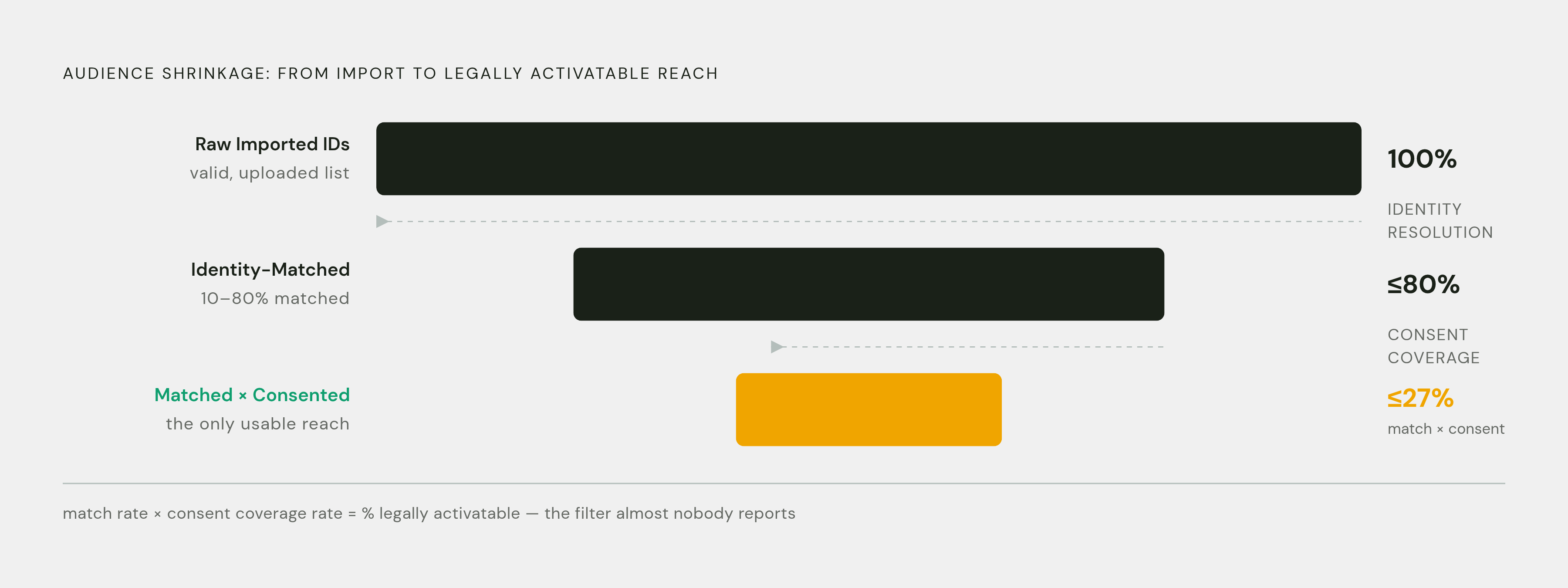
Consent coverage is the percentage of matched profiles carrying a documented, current, purpose-specific legal basis for the exact activation use case at hand.
Purpose-specificity is the detail that trips people up. A profile consented for email marketing isn't automatically consented for paid media retargeting. Purpose limitation under major privacy frameworks makes that distinction explicit, and California's ADMT rules, which require opt-outs whenever automated decision-making substantially replaces human judgment, reinforce it from another angle. One signed consent record does not cover every downstream use.
That gives a cleaner formula for what actually matters: match rate times consent coverage rate equals the percentage of an imported audience that can legally be activated. That's the only number that reflects real, usable campaign reach, not the inflated one sitting on the marketing dashboard.
Consent coverage also needs to work as a live signal, not a quarterly audit. An audit log pulled after something goes wrong is a postmortem, not protection. Consent state needs to be queryable at the exact moment of activation. This means storing consent as a profile attribute right alongside identity attributes, refreshed on the same cadence as behavioral data, not on some separate, slower schedule.
There's an upside here too. BCG research cited in the Nvecta CDP statistics report found that marketers using CDP-powered first-party data generate roughly twice the incremental revenue per ad placement compared to companies running on limited data integration. First-party data tends to carry documented consent more reliably by nature, since it was collected directly from the person, not inferred or purchased. Organizations that report consent coverage as a real metric, not a compliance checkbox buried in a legal review, can say with actual confidence what their activatable reach is. That confidence is what holds up when a media plan gets questioned later.
Differences among CDP vendors in surfacing consent state alongside identity resolution
The cdp.com vendor guide shows five platforms show up most often on enterprise shortlists: Adobe Real-Time CDP, Hightouch, Salesforce Data Cloud, Tealium, and Treasure Data (branded Treasure AI). Each one handles consent and identity a little differently, shaped by its own deployment model.
Tealium leans hardest into compliance-heavy use cases, partly because of its tag-management roots, with over 1,300 pre-built connectors. That heritage puts it in a structurally better spot to route consent signals through the rest of the activation stack, rather than treating consent as a bolt-on.
Salesforce Data Cloud benefits from native CRM integration, meaning consent preferences captured directly in the CRM can, in principle, flow through to activation. How far that actually reaches depends on which destinations get configured, since Data Cloud natively supports consent-aware activation to Marketing Cloud, Sales Cloud, Service Cloud, ad platforms, and file-based destinations.
Hightouch takes the warehouse-native, reverse ETL route: it activates straight from the data warehouse, so consent state stored as a warehouse attribute travels with the profile all the way to activation destinations. That simplifies propagation considerably for teams with mature data infrastructure already in place. Hightouch raised $150 million at a $2.75 billion valuation in April 2026, a sign of real market confidence in that warehouse-native model.
Adobe Real-Time CDP offers ultra-low-latency profile updates across Adobe Analytics, Target, and Journey Optimizer, which suits real-time consent enforcement well, but the benefit largely stays contained inside Adobe's own ecosystem.
Platforms sold top-down through enterprise procurement tend to land at organizations where consent governance is already a boardroom-level concern, while developer-first tools enter bottom-up through engineering teams. Platforms sold top-down through enterprise procurement, ActionIQ at 56.8% enterprise share, Tealium at 50.5%, G2 review data in the cdp.com guide shows, tend to land at organizations where consent governance is already a boardroom-level concern. Developer-first tools, Hightouch at 13.5%, Segment at 11.3% enterprise share, enter bottom-up through engineering teams and often only build out consent infrastructure later, once the organization matures into needing it.
As AI agents start querying CDP data directly, MCP governance tools provide access controls, observability, and governance for what AI agents can actually touch inside the CDP and activation stack. That's a distinct capability from CDP-native consent management itself, but it's increasingly relevant as agentic AI starts pulling and acting on profile data on its own.
The evaluation question every buyer should be asking: does the platform expose consent state as a queryable profile attribute at the exact moment of activation, or is consent managed off to the side, reconciled only periodically, after the campaign's already live?
The practical steps that close the gap between reported match rate and trustworthy activatable reach
Audit the existing matched pool before the next campaign launches, not after. Segment the matched audience by actual consent status: fully consented for the intended purpose, consented for a different purpose entirely, expired, and unresolved or unknown. That segmentation alone usually reveals how much smaller the real activatable audience is compared to the headline match rate.
From there, treat consent as a profile attribute with the same refresh discipline as any identifier, updated on the same cadence, stored in the same place, checked at the same moment. Push for purpose-specific consent capture at the point of collection, rather than a single blanket opt-in that gets stretched to cover every future use case someone dreams up later.
Vendor selection matters here too. Ask directly whether consent state is queryable live at activation, or whether it's reconciled on a schedule that lags behind the identity data feeding the campaign. And report consent coverage next to match rate, every time, in every dashboard that marketing and legal both look at. A match rate without its consent coverage number is a ceiling nobody's checked whether they're actually allowed to hit. It's a ceiling nobody's checked whether they're actually allowed to hit.