Net Promoter Score Correlation With Perceived Data Control
Customers reward data control with loyalty, not marketing promises.
The 2025 PLOS ONE study of Swiss financial services consumers is the most rigorous current evidence that trust is not a soft NPS input but the primary one, with high-trust customers producing a strongly positive NPS, low-trust customers producing a strongly negative one, and a swing that spans the full scale. Most customer experience teams don't treat trust that way. They spend budget on faster checkout, cleaner interfaces, and better promotions while the actual architecture of trust, how a company handles a customer's data, goes untouched.
NPS swings of 100+ points trace back to trust, not surface-level CX
NPS itself is a single "likelihood to recommend" question on a 0–10 scale, with detractor share subtracted from promoter share to produce a result running from -100 to +100. Scores above 50 count as excellent by most industry benchmarks. Survicate's 2025 benchmarks, covering data from millions of responses, show median NPS across all industries, with manufacturing leading at 65 and software at the bottom at 30. Even that gap is smaller than the swing a single trust event can produce inside one company. A customer who trusts a bank produces a strongly positive NPS on average, while a customer who doesn't produces a strongly negative one. That's larger than the distance between the best-performing industry and the worst.
The Swiss study focused on financial services, a sector where handling money and personal data is the entire product, so the size of the effect there shouldn't be assumed to transfer at the same magnitude everywhere. The direction of the finding, that trust drives NPS more than convenience or price does, lines up with later results in sectors as different as telecom and auto retail. The financial services context is a strong starting point for a broader pattern.
Which trust dimensions move the score
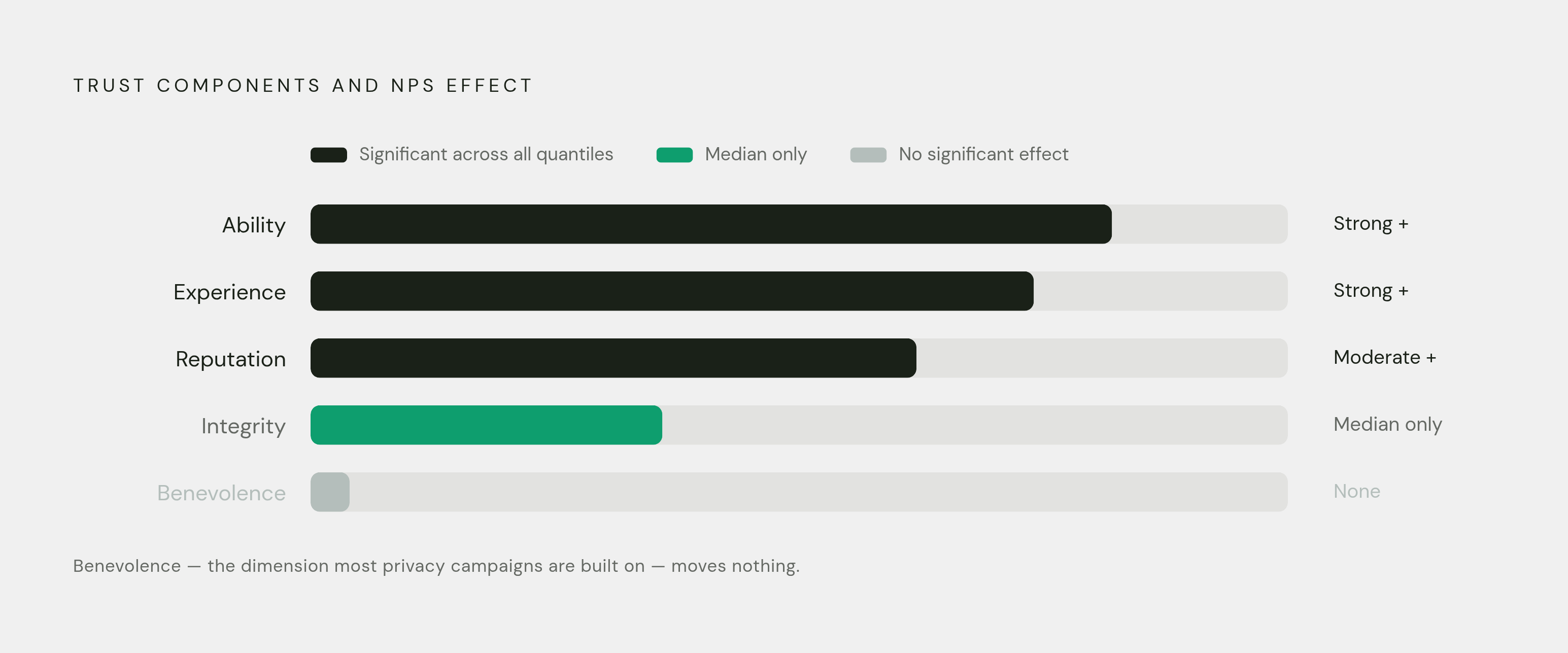
Trust isn't one thing, and the study didn't treat it as one thing. Researchers broke it into components and ran quantile regression across the full range of company performance. Ability, experience, and reputation drive NPS consistently across all performance levels, while benevolence has no significant effect at any quantile and integrity's effect is limited to median-performing relationships. Ability means perceived competence at handling a customer's data correctly. Experience means a track record of doing that without incident. Reputation means how visible and legible that track record is to people outside the company.
Then there's benevolence: the sense that a company means well, that it cares. It showed no significant effect on NPS at any quartile. Integrity mattered, but only for companies performing in the middle of the pack, not at the top or bottom.
That's the finding that should change how companies allocate budget. Plenty of privacy campaigns are built entirely around conveying good intentions: "we care about your data," "your privacy matters to us." According to this data, that message doesn't move the number that supposedly measures loyalty. Customers are asking whether a company has demonstrated it, not merely whether it means well. They're asking whether it has demonstrated, through a track record, that it actually knows what it's doing with their information.
McKinsey research backs this up from a different angle: a large share of U.S. consumers say they'll switch brands over data practices they don't trust, and the trigger is what the company does, not what it says it intends to do. Perceived data control is a judgment customers form from evidence, not a feeling a marketing team can manufacture with the right copy. It's a judgment customers form from evidence.
The personalization paradox in practice
Personalization runs on data. The more a company knows about a customer, the sharper it can tailor recommendations, pricing, and outreach. That same data collection makes customers feel like they've lost control, a tension that drives most modern CX strategy. Research published on this problem in 2025 names it the personalization paradox: the more a company leans on advanced analytics to personalize, the more it triggers privacy concerns that undercut the trust personalization was supposed to build.
The fix is making the data relationship visible and purposeful. That looks like using anonymized or aggregated models where full identification isn't needed, building personalization that feels like it's working for the customer rather than watching them, and treating privacy as a deliberate design choice rather than something bolted on to satisfy a legal team. PwC's 2025 Customer Experience Survey frames this approach as a competitive advantage over compliance cost.
Not every customer weighs this the same way. Security Magazine reporting found that Baby Boomers are most likely to shift shopping behavior following a breach, while Baby Boomers' counterparts show different stakes depending on which customer segment an organization is most exposed to. So the stakes of the personalization paradox depend heavily on which generation makes up the bulk of a company's customer base. A bank serving an older customer segment carries more exposure here than a social app built for teenagers.
Evidence from companies that got it right, and one that didn't
The cases below aren't just illustrations. They trace the full consequence chain, in both directions, from perceived data control to NPS outcome.
Apple ran a 2025 campaign built entirely around the line "Privacy. That's iPhone," aimed squarely at customers fatigued by a string of high-profile breaches elsewhere. Merren CX benchmark data shows Apple's NPS is well above the Consumer Electronics category average. The pitch wasn't "we care." The claim was not "we mean well" but "we have built systems that structurally protect your data," illustrating ability and reputation as NPS levers.
National Public Data shows what happens at the other end. In August 2024, the company suffered a breach that exposed personal information, including Social Security numbers, addresses, and phone numbers, for hundreds of millions of people across the US, UK, and Canada. The company subsequently filed for Chapter 11 bankruptcy, facing over a dozen lawsuits and potential liability. This isn't a case of NPS dipping for a quarter. Loss of perceived data control led to loss of trust, which led to the company folding.
T-Mobile sits in between, and it complicates any assumption that a breach permanently wrecks a brand. The company paid $350 million to settle customer class-action claims tied to a breach, then reached a further FCC settlement in 2024 covering that incident and others. T-Mobile's NPS has been cited at 82, against a telecom sector average that CustomerGauge puts at 34 and Merren CX puts at 22. That's evidence that transparent remediation and visible follow-through on data control can rebuild promoter behavior even in a sector where trust runs low to begin with, even though breaches do cost companies trust.
CDK Global's research on auto dealerships shows the same mechanism at work outside privacy entirely. Buyers who get visibility into every step of a purchase, what's happening, why, and what their options are, report feeling like they're working with the dealer rather than being sold to, and that sense of control tracks with higher trust in the process. Control over a purchase journey produces the same promoter behavior as control over personal data. The mechanism isn't specific to privacy. It's specific to whether people feel like they can see and shape what's happening to them.
The measurement gap most CX programs miss
Most companies are pouring more money into loyalty programs without a reliable way to tell what's actually moving the needle. PwC's Customer Experience Survey found a large majority of executives reporting both rising loyalty investment and a shortage of measurement tools to justify it.
The critique of NPS as a metric deserves honest treatment here, not dismissal. Timothy L. Keiningham, a marketing professor at St. John's University, has pointed out that shifts in NPS show almost no relationship to how customers actually divide their spending across competitors. Keiningham has emphasized that changes in NPS have almost no relationship to how customers divide their spending; a privacy investment that raises NPS may not translate to revenue without supplementary metrics.
Scrapping NPS means pairing it with retention data, lifetime value, and actual switching behavior, since NPS reads as a leading indicator of sentiment rather than a direct stand-in for revenue. For AI-era products, NTT DATA's 2025 analysis argues that understanding NPS drivers in generative AI contexts requires pairing quantitative scores with qualitative NLP analysis of open-ended responses, capturing user concerns around latency, explainability, and privacy.
Most existing research, before the PLOS ONE study, treated trust as one undifferentiated thing, so nobody could see which specific components were doing the work; unidimensional trust measures could not reveal that ability and reputation matter while benevolence does not. Programs built on those older measures are, by construction, calibrated to the wrong signals.
AI and the new perceived-control problem
AI has raised the stakes on all of this. TrustArc's Global Privacy Benchmarks Report found that it now ranks as the top challenge in privacy management, with a substantial share of organizations rating it very or extremely challenging and a notable share reporting AI-related vulnerabilities directly. Pew Research Center data, cited in Enzuzo's privacy statistics compilation, shows a majority of U.S. adults believe wider AI use will make their personal information less secure. That belief holds even when the AI system behind the scenes is genuinely well-governed, because customers are reacting to a perception gap, not just measuring actual risk.
The mechanism is straightforward. Customers experience AI as an opaque layer processing their data, one they can't inspect or steer, and that opacity lands directly on the ability and reputation dimensions the PLOS ONE study identified as the real NPS drivers. A company can have flawless data governance internally and still take an NPS hit if customers can't see any evidence of it.
Some organizations are responding by testing co-created privacy policies and similar mechanisms that give customers a visible, legible say in how their data feeds AI systems. That's control moving out of a legal document and into the actual product experience. TrustArc's data shows organizations prepared for regulations like the EU AI Act and Colorado's AI Act score well above the overall Privacy Index average, and the traits distinguishing them are concrete: data inventory and mapping, third-party privacy certifications, active data discovery, a maintained Trust Center, and a working process for data subject rights requests. That's operational infrastructure customers can eventually see evidence of, standing apart from a policy statement asking to be believed.
Compliance and NPS costs, converging
Regulators have made the cost of failing at data control explicit and countable. The DLA Piper GDPR Fines and Data Breach Survey, cited in Enzuzo's compilation, found that cumulative GDPR fines since 2018 have reached into the billions of euros, with a substantial amount added in 2025 alone. That's a financial number sitting right alongside the NPS number, and they're both measuring the same underlying failure.
Cisco's Data Privacy Benchmark Study found that a large majority of organizations say their privacy investments return more than they cost, with a meaningful share reporting returns of more than double the original spend. The single most cited benefit was customer loyalty and trust, ahead of operational efficiency, innovation, and reduced losses from security incidents.
Companies that treat data control as a checkbox for auditors end up paying for it twice: once as a straight cost center, and again through NPS erosion and regulatory exposure when the underlying practice doesn't hold up. Companies that build it as something customers can actually see and interact with turn the same spending into a driver of loyalty and revenue. TrustArc's data shows organizations with more than three privacy solutions fully deployed scoring meaningfully higher on the Privacy Index, and 88% of companies surveyed cite brand trust as their top motivator for privacy investment in the first place.
That logic extends directly into how companies manage AI internally. Where AI agents and connected tools are reaching into core systems and customer data, the same governance work that produces visible data control for customers, data inventory, access controls, real-time observability, a defined and governed path for rolling out new tools, is what keeps AI from operating in the shadows inside the company. Organizations that build that layer on purpose tend to move faster on deploying AI in production, not slower, because clear guardrails are what let a company say yes to a new use case with confidence instead of hesitating over what might go wrong. The companies that treat this governance work as a source of advantage, rather than a burden imposed from outside, are the ones positioned to hold the trust of regulators and customers at the same time.
Sources
- 1 2025 Global Privacy Benchmarks Report
- NPS Benchmarks 2025: What is a Good Net Promoter Score?
- Updated 2025 NPS Benchmarks by Industry & Trends | Merren CX
- Net promoter score
- The trust–NPS correlation: The role of trust in promoting customer loyalty in Swiss financial institutions
- The loyalty illusion: PwC 2025 Customer Experience Survey