Consent Rate Impact on Programmatic CPM and Fill Rates
Missing consent signals silently tank CPM and fill rates.
How a consent signal breaks down before a bid is placed
Consent rate decides whether an impression sells at addressable rates or gets dumped into the commodity pile with everyone else's leftover inventory. Programmatic runs most of US display spend now, so the mechanics of how one impression gets priced and filled aren't a side detail. They're the business itself, and most publishers still treat consent rate like a compliance footnote instead of the revenue lever it actually is.
Most publisher dashboards show eCPM, fill rate, and RPM. Consent rate lives somewhere else, usually in a CMP report that a different team checks on a different schedule. That gap between the two dashboards is where money disappears, session after session, without ever showing up on the monetization side of the house.
A user lands on a page, the CMP fires, and it generates a TCF consent string that flows through the header bidding wrapper, into the ad server, out to every SSP endpoint, and through any identity or first-party data module in the stack. When that string doesn't make it through cleanly, DSPs read the signal as ambiguous or missing and the bid never fires. The demand evaporates before the publisher ever sees it happen.
Three failure points cause most of this. Timing is the first and most common: the CMP resolves its consent decision after Prebid has already fired off bid requests, so demand partners get requests with no valid signal attached and drop out, leaving the auction thin before it even starts. Malformed or outdated strings cause the second kind of failure. Major SSPs run strict validation now, and if the string conflicts between what the CMP recorded and what the ad server has, the SSP treats the impression as non-addressable, even if the user clicked "accept all." The third failure is version mismatch: publishers still running older TCF configurations may find their purpose flags or vendor declarations read as incomplete by buyer systems, which is a bid-eligibility failure, not a legal one.
The TCF migration timeline makes fixing this more urgent, not less. Google announced on November 3, 2025 that publishers and CMPs had until March 1, 2026 to move to TCF v2.3, a deadline that has already passed. Strings generated without the required disclosedVendors segment now get treated as invalid, and ad requests default to Limited Ads: non-personalized, contextual only. IAB TCF has since pushed out v2.4, adding disclosures for vendor Features, cross-device consent flexibility, and a simplified Legitimate Interest signal for Special Purposes. Web environments need to comply by October 23, 2026. Mobile and CTV follow on February 23, 2027.
Google's Consent Mode v2 adds another layer on top of all this. It's been mandatory since March 2024 for EEA use of Google products, and without a valid TCF string, Google defaults to Limited Ads. Starting July 21, 2025, Google began restricting data collection from sites that don't transmit consent signals through Consent Mode v2, and remarketing lists get disabled entirely for non-compliant EEA and UK traffic.
A publisher whose CMP dashboard shows a high acceptance rate can still be sending a large chunk of bid requests with no valid consent attached. The dashboard and the auction are telling two different stories, and only one of them pays the bills.
The CPM gap between consented and non-consented inventory
Addressable impressions average a CPM well above what Safari, iOS, or non-consented audiences fetch. Research from Digiseg and AdExchanger puts that spread at a severe level, and the penalty reflects something specific: non-consented inventory doesn't get a discount, it gets shoved into an entirely different tier of the market.
Early post-GDPR data backs this up hard. Ad tech vendor Sovrn observed a meaningful yield jump on inventory carrying consent strings versus inventory without them, and ad server Smart estimated CPMs run five to seven times higher when a valid consent string is attached. Adnimation found a similar split: sites without a consent management tool saw CPMs drop sharply after GDPR, while sites running one captured much higher CPMs through consent-driven targeting. In European mobile apps, inventory carrying TCF 2.0-or-later strings earns substantially higher eCPMs than inventory stuck on older Boolean-based consent.
Under current Google policy, a missing or invalid TCF string triggers non-personalized, contextual-only serving, which sets a lower CPM floor for that inventory. Cookieless CPMs run lower than cookie-based CPMs too, mostly because targeting gets less precise, though the Index Exchange Cookieless Impact Study (cited in an IAB and Statista compilation) shows that gap narrowing as contextual and first-party approaches mature. A 2024 study in the Journal of Marketing Research, analyzing over 3.7 billion ad impressions, found contextual targeting can claw back a real chunk of the conversion and revenue-per-click loss that comes from missing personal data. Clawing back part of the loss doesn't close it, though. Pubstack's data science study found roughly a 40% gap in revenue per thousand between the "consent not available" state and the "consent accepted" state.
The takeaway publishers keep missing: this is a separate pricing tier, and a lot of publishers sitting in that lower tier have no idea they're even in it. It's a separate pricing tier, and a lot of publishers sitting in that lower tier have no idea they're even in it.
Fill rate as the second revenue channel consent controls
CPM isn't the only lever consent pulls. Fill rate is the other one, and it behaves differently: when a consent signal is ambiguous or missing, demand-side platforms don't just bid lower, they often skip the auction. The impression gets pulled out of the pool before pricing ever becomes a question.
Data on European app inventory has found that impressions carrying valid TCF 2.0+ strings get filled at substantially higher rates than impressions passing no consent information. That's a fill-rate gap, not a pricing gap, and it stacks on top of the low CPMs instead of sitting next to them.
The broader market isn't making this easier. DataBeat's US Programmatic Trends Report shows fill rate falling from 42% in Q1 2024 to 38% in Q1 2025, as demand softens and buyers get pickier about privacy compliance. Defending fill rate at the publisher level matters more now, not less.
Standard fill-rate reporting hides the real damage, too. A dashboard counts an impression as "filled" the moment any bid clears, even a low one. It has no way to show that a missing consent signal already chased off three or four higher-value bidders before that low bid ever showed up. rCPM, which measures revenue per thousand ad requests rather than per thousand served impressions, is the metric that actually catches this. It counts unfilled and under-monetized requests as zero, which makes consent-driven auction thinning visible in a way eCPM never will. A publisher can watch eCPM hold steady while rCPM quietly erodes underneath it, because fill quality is degrading exactly in the request segments where consent signals are weakest.
What the revenue gap looks like at auction scale
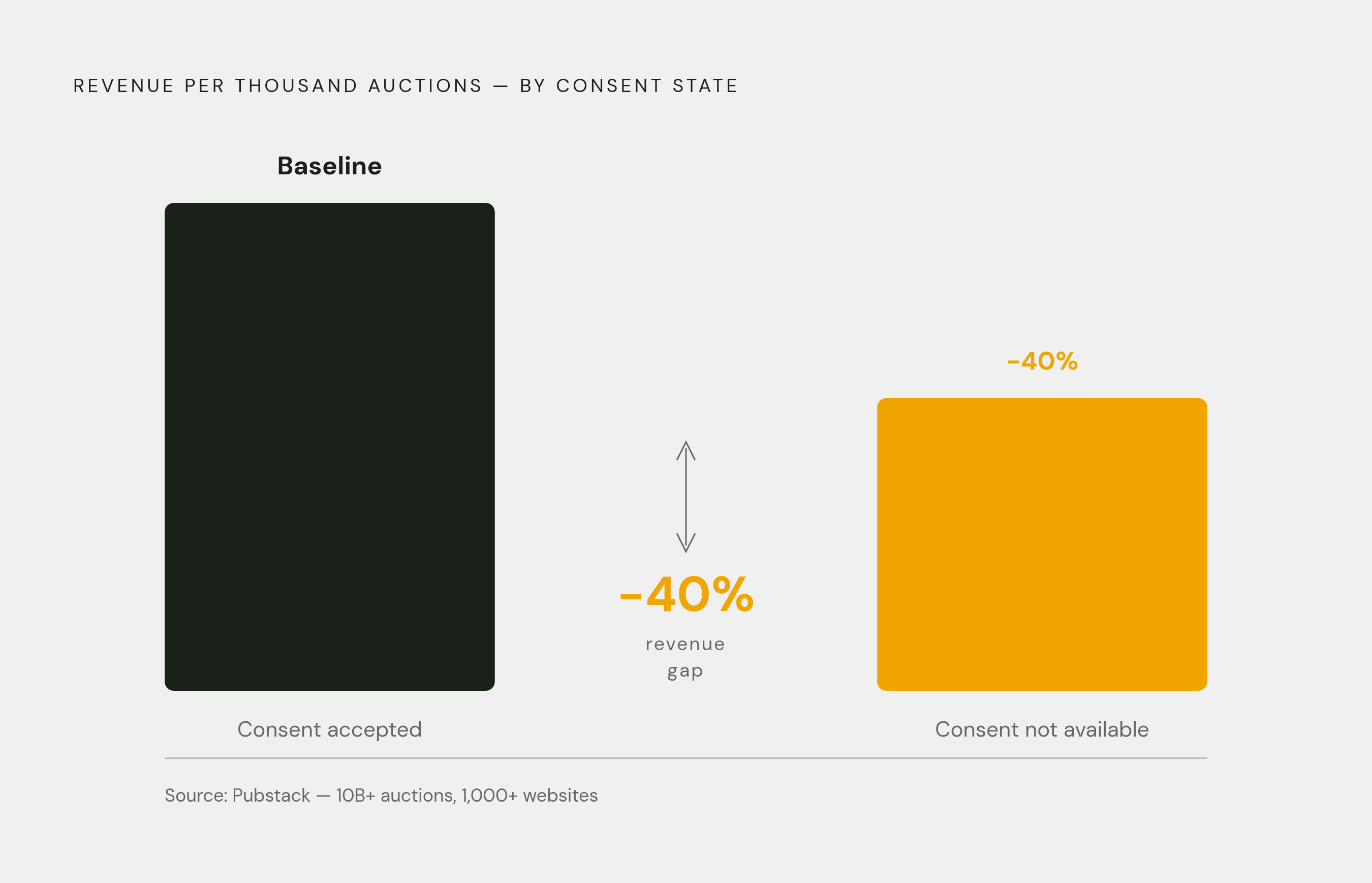
Pubstack ran a data science study across more than 10 billion auctions on over 1,000 websites and found roughly a 40% gap in revenue per thousand between the "consent not available" state and the "consent accepted" state. That's nearly half the revenue on the table, tied directly to whether a valid signal made it to the auction.
The methodology is what makes this number trustworthy. Pubstack measured outcomes at the bid-request level, not through user session proxies, which makes it a sturdier dataset than most CMP-reported acceptance numbers. And that's where the real finding sits: a CMP can report a high acceptance rate while a meaningful share of auctions still fire with no valid consent attached. A CMP that's badly implemented on even part of a site creates a hidden "consent unavailable" bucket that standard CMP reporting never shows.
That gap turns consent rate into a revenue operations problem instead of a legal one. The number the CMP reports and the number that actually reaches the auction are two different numbers, and treating them as interchangeable is how publishers lose track of the gap to begin with.
Industry-wide figures confirm the pattern isn't isolated. Industry research has found that a large share of ad requests weren't passing adequate consent strings, with most apps defaulting to Boolean-based consent or invalid strings rather than TCF 2.0. Research on GDPR cookie banner compliance has found wide variance in outcomes depending on how a CMP is implemented, and how that CMP gets configured materially changes whether consent collected on the page ever reaches the auction. Publishers measuring consent at the CMP report level and calling the job done are measuring the wrong number. The number that matters is the share of bid requests carrying a valid, current consent string, and most publishers have never checked it.
Where consent rates stand, and how much headroom exists
FlexyConsent's 2026 benchmark data puts average EU consent rates somewhere in the 55% to 65% range, with top-performing sites reaching 75% to 85%. That gap between median and top performance is large enough to represent a fundamentally different revenue outcome for two sites competing in the same market.
Broader industry data from Kukie.io shows an overall average consent rate between roughly 42% and 47%, with individual sectors diverging sharply from that midpoint. FlexyConsent's regional breakdown within Europe tells its own story: Western Europe (Germany, France, Netherlands, Belgium) is 50% to 60%, reflecting a privacy-conscious, tightly regulated user base. Southern Europe (Spain, Italy, Portugal, Greece) runs higher, at 60% to 70%. Northern Europe (Sweden, Norway, Denmark, Finland) is 55% to 65%. Eastern Europe (Poland, Czech Republic, Romania, Hungary) tops the list at 65% to 75%.
Vertical differences matter just as much as geography, arguably more. A healthcare site and an ad-tech platform can operate under the exact same regulatory framework and still post consent rates 40 percentage points apart. It's a difference in audience trust and category norms, not a compliance failure on either side, and any publisher reading its own numbers needs to factor that in before comparing itself to a benchmark that doesn't apply. It's a difference in audience trust and category norms, and any publisher reading its own numbers needs to factor that in before comparing itself to a benchmark that doesn't apply.
A structural ceiling, caused by privacy settings, incognito browsing, and browser-level restrictions limiting addressable traffic, underlies all of this too. By 2022, only around 30% of web traffic remained addressable through traditional methods, thanks to privacy settings, incognito browsing, and browser-level restrictions. In a stricter opt-in environment, that ceiling matters even more, and it can fall further before it rises. IAB Netherlands' Privacy Impact Assessment found the Dutch programmatic market lost an estimated 8% to 12% of addressable audience compared to markets with looser enforcement, which shows the regulatory environment itself sets a floor that CMP optimization has to work within, not around.
Still, the real opportunity sits in the gap between median performers and top performers. A publisher near the median who closes even half that distance moves a meaningful share of inventory out of commodity pricing and into addressable pricing, and that's a decision, not a fluke of geography.
CMP design choices that move consent rates and the revenue lift they produce
Format is the single highest-leverage lever a publisher controls, full stop. Pop-in CMP formats tend to achieve substantially higher consent rates than standard banner formats, a gap large enough to shift which pricing tier most of a site's inventory falls into. That gap is large enough on its own to flip which pricing tier most of a site's inventory falls into.
Title copy compounds the effect. Research into banner design has found that adding an explanatory title can lift consent rates substantially, while CMPs running with no title at all tend to see notably lower opt-in. Localization adds another layer on top: banners written in the visitor's native language and thoughtfully styled button placement are additional design factors that practitioners report can add meaningful lift.
Testing moves the needle more than any single design choice by itself. Consentmanager.net's product documentation notes that built-in A/B testing can route traffic to the best-performing banner variant, delivering average lift up to 15%, and the strongest setups test layout, copy, and button placement per audience segment instead of running one static banner for everyone.
The revenue math is straightforward once the numbers are in front of you. A publisher converting at roughly 40% opt-in is only monetizing that slice of its audience addressably. Pushing that rate to 65% through better UX and tested banner variants expands the addressable inventory pool directly, session by session, and the effect holds beyond any single region. Optimizing the consent tool produces a measurable CPM lift across total inventory, not just traffic from one market, so a publisher with a large US and global audience often sees more absolute dollar impact from that lift than from any single regional push.
None of it happens automatically, though. Publishers already running well-designed CMP setups are hitting opt-in rates near the top of the benchmark range right now; the gap between where most publishers sit and best practice isn't theoretical. Someone else is capturing that revenue at this exact moment. And Pubstack's finding about the divergence between CMP-reported acceptance and actual auction-level transmission means banner optimization alone isn't the finish line: the string still has to travel correctly through the entire stack, or the design lift never converts into real auction revenue.
Treating consent infrastructure as a permanent revenue operations function
Signal loss isn't a phase publishers grow out of. Browser restrictions, privacy regulation, and stricter SSP validation are structural forces, and none of them are reversing course anytime soon. TCF v2.4's rollout, web compliance by October 23, 2026, mobile and CTV by February 23, 2027, means the technical bar for a valid consent string keeps moving. Publishers who treat CMP configuration as a one-time setup will keep falling out of step with buyer systems as those systems evolve around them.
The core operational failure is visibility. Standard revenue reports don't surface consent signal breakdowns, so rCPM by consent state, bid request validity rates, and TCF string version coverage need to become metrics someone actually owns, reviewed on the same schedule as eCPM and fill rate, not filed away in a quarterly compliance memo. The consent signal is the bridge between what a user actually agreed to and what any automated system in the ad stack is allowed to do with that data. Publishers who build real visibility into that bridge are the ones who adapt as regulation and buyer requirements keep tightening around everyone else.
Publishers closing the gap between what the CMP records and what the bid request actually transmits, at the right TCF version, to every demand partner, are turning regulatory pressure into a real competitive edge over publishers still treating consent as a box to check. Audit the share of bid requests across every inventory segment that carry a valid, current TCF string, then compare that number against the CMP's reported acceptance rate. The distance between those two numbers is the revenue this piece has been pointing at from the start.